Is Bitcoin Correlated to Stocks? What the Data Says
Is bitcoin correlated to the stock market? Most people assume it is. The popular version goes like this: Bitcoin is a high-octane tech stock, so when the S&P rips, Bitcoin should rip harder. A record-high stock market should mean a flying Bitcoin. Instead, the S&P 500 has made 24 new all-time highs in 2026, and Bitcoin is roughly 49% below its October 2025 peak. Same economy. Opposite directions. That gap has a reason, and the data makes it clear.
How much do Bitcoin and stocks actually move together?
If you measure year by year, the answer is all over the place. In some years they move in the same direction. In others they move apart. The yearly link has swung from slightly negative in 2019 to moderately positive in 2022, and back down again. There is no stable, reliable connection to lean on.
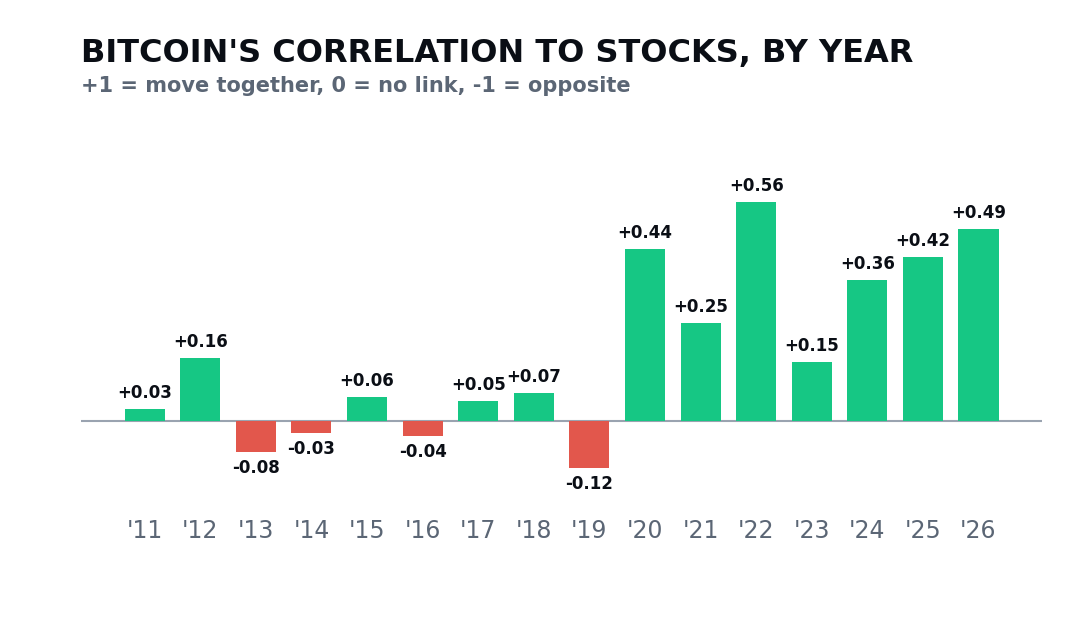
Over the full history, the long-run average sits around 0.16. What that means in plain English is that roughly 3% of Bitcoin's price moves are explained by what the stock market does. The other 97% comes from somewhere else entirely. If you tried to predict Bitcoin using only the S&P 500, you would be right about as often as a coin flip.
The asymmetry nobody talks about
Here is the part that cracks it open. It is not just about how much they move together. It is about when.
When stocks are rising, the link between Bitcoin and the S&P is almost nothing, around 0.09. Bitcoin does its own thing while the market climbs. But when stocks are falling, the link jumps to 0.41. Bitcoin holds the market's hand on the way down and lets go on the way up.
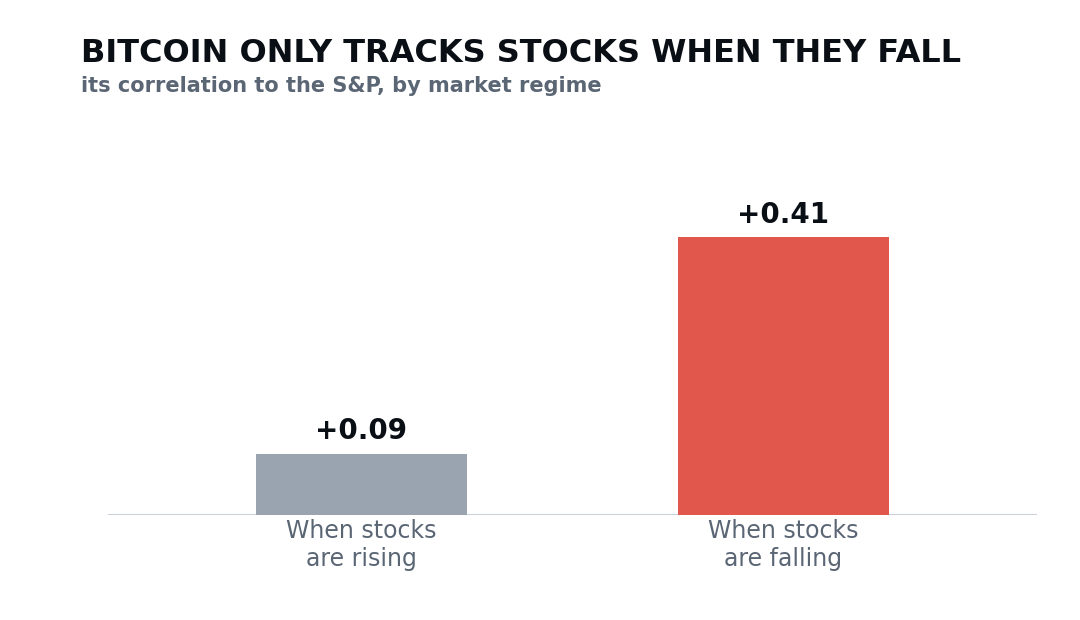
This is the opposite of what most people expect. The popular logic says a stock market at all-time highs means Bitcoin is safe. But that logic leans on the up-link, and the up-link is the weak one. The strong link only fires during a selloff, and then it just drags Bitcoin down too. You get the downside tag-along, not the upside.
Why Bitcoin split from stocks in 2026
Since Bitcoin's October 2025 peak, the S&P 500 is up about 12%. A simple model using Bitcoin's historical sensitivity to stocks would have predicted Bitcoin should be up about 9% over that same stretch. Instead it is down 49%. That is a 58-point gap between what stocks predicted and what actually happened.
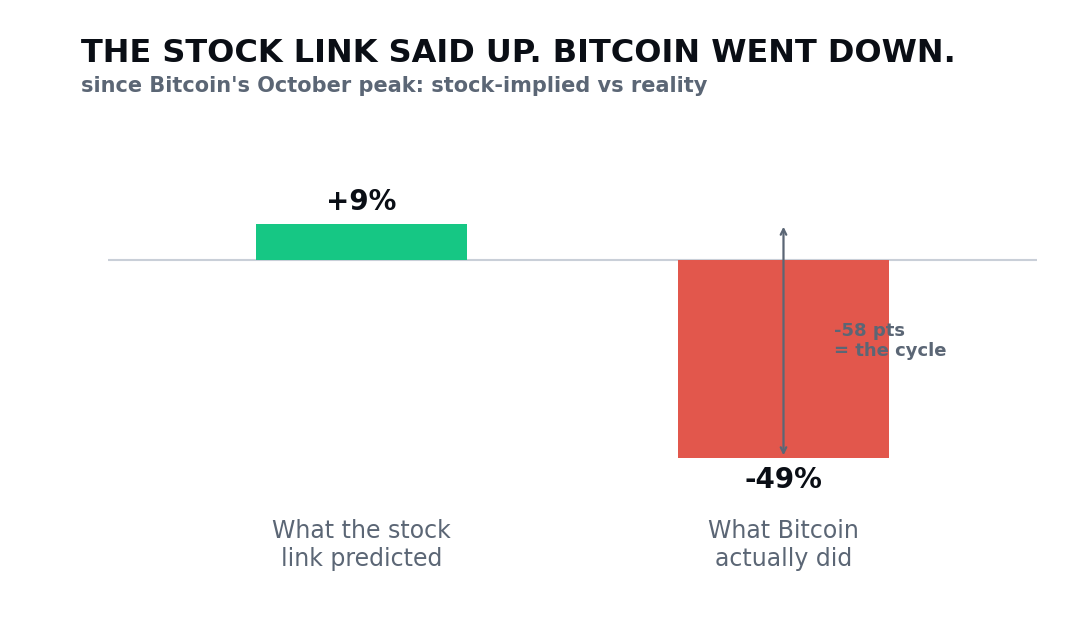
So where did that 58-point gap come from? Not from the economy. Not from the Fed. Not from earnings season. It came from Bitcoin's own internal rhythm. Bitcoin runs on a roughly four-year cycle tied to its halving schedule, and that cycle is currently in its bear phase. That is the force overriding the stock signal right now, and it has done the same thing in every previous cycle.
What actually drives Bitcoin's price
Even in the current environment, where the short-term link looks higher than usual, roughly three quarters of Bitcoin's moves have nothing to do with the stock market. The primary driver is Bitcoin's own supply schedule. Every four years the protocol cuts the rate of new coin creation in half. That event reshapes the supply-demand balance on a timeline that has nothing to do with what the S&P 500 or the Federal Reserve is doing.
This is why borrowing stock-market intuition wrecks people. They see green indexes and assume Bitcoin must be healthy. They expect it to bounce on the same timeline stocks do. It runs on a different clock, with swings several times larger. A stock market crash can still take Bitcoin down with it (that is the asymmetry at work). But a stock market rally will not save Bitcoin from its own bear.
What this means for you right now
The S&P 500 is about 1% from its all-time high. Bitcoin is about 49% below its high, deep in its own cycle. A green stock market tells you almost nothing about where Bitcoin is headed. If you are making Bitcoin decisions based on what the Dow or the Nasdaq did today, you are reading the wrong scoreboard.
Judge Bitcoin by its own cycle, its own supply schedule, and its own history. That is what fifteen years of data says drives the price. The stock market is a background character, not the lead.
I break down the data on Bitcoin like this every day, free, on Instagram. For the full daily breakdown and to trade alongside the community, come to bitcoindaily.vip.
Educational, not financial advice. Every cycle is different and past performance is not a guarantee.
Common questions
Is Bitcoin correlated to the stock market?
Weakly. The long-run average link between Bitcoin and the S&P 500 is about 0.16, meaning stocks explain roughly 3% of Bitcoin's price moves. The other 97% is driven by Bitcoin's own cycle and supply schedule.
Why is Bitcoin down when the stock market is up?
Bitcoin runs on its own roughly four-year cycle tied to its halving schedule. That cycle is currently in its bear phase, which is overriding the positive stock market. The link between them is weakest when stocks are rising.
Does Bitcoin go up when the S&P 500 goes up?
Not reliably. When stocks are rising, the link between Bitcoin and the S&P is close to zero (around 0.09). Bitcoin tends to move independently during stock market rallies. The connection only strengthens during selloffs.
Is Bitcoin a good hedge against stocks?
Not exactly. Bitcoin couples with stocks during crashes (the link jumps to 0.41 in falling markets) but decouples during rallies. You get the downside tag-along without the upside diversification, which is the opposite of a hedge.
What drives Bitcoin's price if not stocks?
Bitcoin's own four-year halving cycle is the dominant force. Roughly every four years, the protocol cuts new supply in half, reshaping the supply-demand balance on a timeline independent of the stock market or the Federal Reserve.
Keep reading
We break down the market like this every day, free on Instagram and YouTube, and in depth inside the community.
Education, not financial advice. Trading involves real risk.
See it live on the charts