Bitcoin Halving Explained: Why It Moves the Price
Every four years, something happens to Bitcoin that has preceded every single major price run in its history. It is called the bitcoin halving, and if you own any Bitcoin or plan to, this is the one event you need to understand. Not because it guarantees anything. Because the pattern it has created over 15 years is the most consistent one in all of crypto.
What is a bitcoin halving?
Bitcoin runs on a network of computers called miners. These miners process transactions and, in return, earn brand-new Bitcoin as a reward. The halving is when that reward gets cut in half.
When Bitcoin launched in 2009, miners earned 50 BTC for every block they processed. In November 2012, the first halving cut that to 25. In July 2016, it dropped to 12.5. In May 2020, it fell to 6.25. And in April 2024, it was cut again to 3.125 BTC per block.
This is not a decision anyone makes. It is written into Bitcoin’s code from day one. Every 210,000 blocks (roughly every four years), the reward automatically halves. No vote, no committee, no central bank. The code just runs.
Why the halving matters for price
Think of it like this. Imagine a gold mine that produces 100 ounces a day. Overnight, a switch flips and it can only produce 50. If the number of people who want gold stays the same (or grows), but the new supply just got cut in half, the math tilts toward higher prices.
That is exactly what the bitcoin halving does to new supply. Right now, about 450 new BTC enter the market every day. After the next halving (expected around March 2028), that drops to about 225. Meanwhile, over 95% of all Bitcoin that will ever exist has already been mined. There are only about 1 million BTC left to create, ever.
Less new supply hitting the market, with the same or growing demand: that is the simple logic behind why halvings matter.
What happened after every bitcoin halving
Here is the part that gets people’s attention. After every halving in Bitcoin’s history, the price went on a massive run within the following 12 to 18 months:
- 2012 halving: Bitcoin was around $12. Within a year, it hit over $1,000.
- 2016 halving: Bitcoin was around $650. Within a year, it was above $2,500, and kept running to nearly $20,000 by the end of 2017.
- 2020 halving: Bitcoin was around $8,700. Within a year, it topped $55,000.
- 2024 halving: Bitcoin was around $63,000. It ran to an all-time high above $125,000 in October 2025.
Four halvings. Four massive runs. The size of each run has gotten smaller in percentage terms (the first was nearly 9,000%, the latest roughly 100%), but even a “small” move from $63,000 to $125,000 is a doubling.
Does this guarantee the pattern continues? No. Past performance never guarantees future results. But four out of four is a pattern worth understanding.
Where we are right now
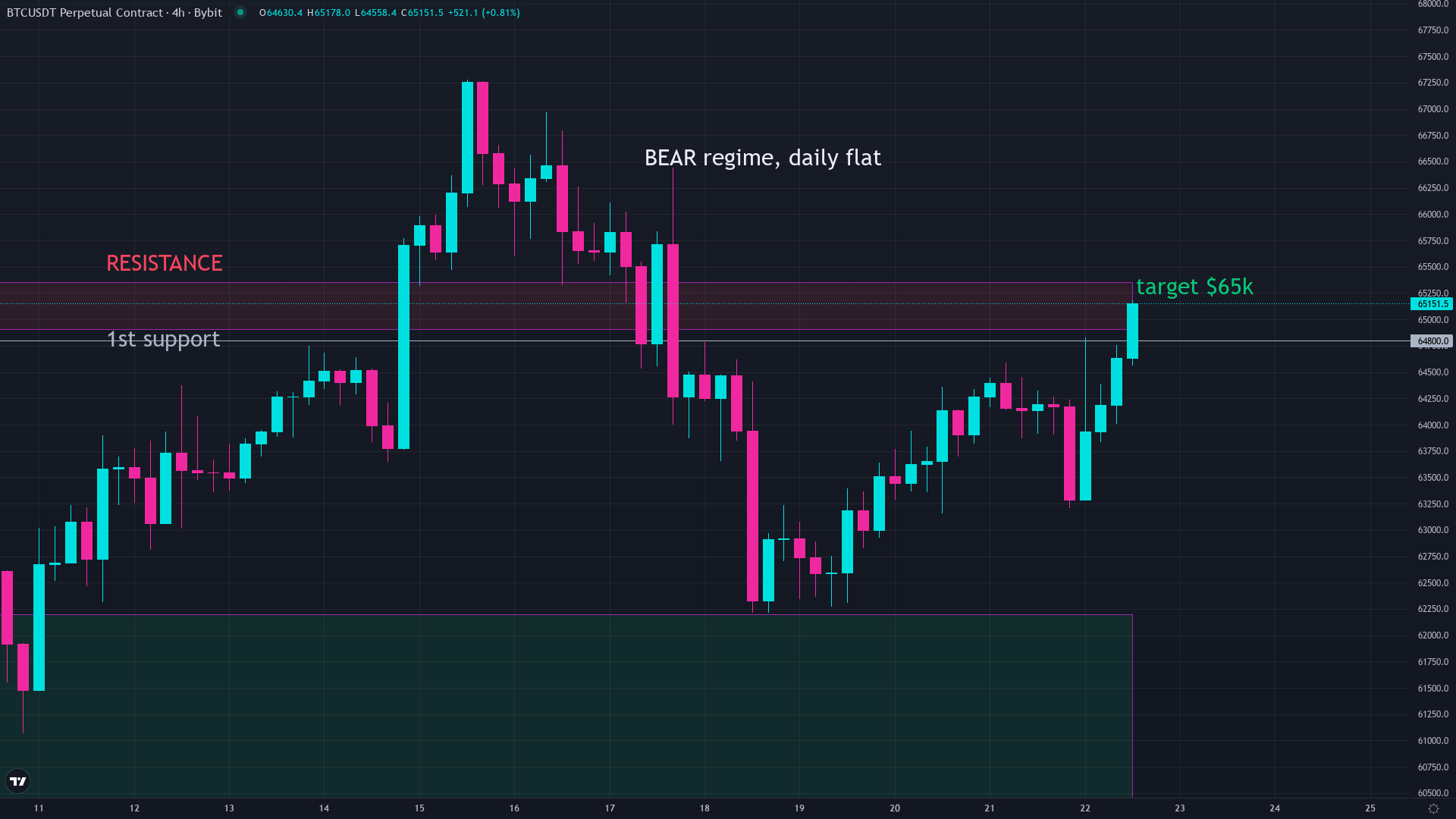
Today, June 22, 2026, Bitcoin trades around $65,000. That is roughly 48% below the October 2025 all-time high of about $125,800. The Fear and Greed Index sits at 20, which is labeled Extreme Fear. We are 793 days past the most recent halving and deep into what historically looks like the post-peak cool-down phase of the cycle.
If history rhymes (not repeats, rhymes), the bear market eventually gives way to a bottom, and the next halving in 2028 sets up the next cycle. Every prior cycle has followed this rough script: halving, run, peak, crash, grind, next halving. We are in the grind.
None of this is a prediction. It is just the pattern, laid out honestly. The grind is where most people quit. It is also, historically, where the best prices have appeared.
The shrinking reward and what it means long-term
Each halving matters a little less to new supply because there is simply less new Bitcoin being created. Going from 50 BTC per block to 25 was a shock. Going from 3.125 to 1.5625 in 2028 is a smaller absolute change. But here is the flip side: each halving also means Bitcoin’s inflation rate keeps falling. After the 2024 halving, Bitcoin’s yearly inflation rate dropped below 1%, making it scarcer (in new-supply terms) than gold.
That matters because Bitcoin’s total supply is capped at 21 million coins, forever. There will never be more. The last full Bitcoin is expected to be mined around the year 2140. Every halving is one more step toward that hard cap, and one more reason the existing supply becomes more significant over time.
Common questions
When is the next bitcoin halving?
The next bitcoin halving is expected around March 2028, at block height 1,050,000. The block reward will drop from 3.125 BTC to 1.5625 BTC per block.
How many bitcoin halvings have there been?
There have been four bitcoin halvings: November 2012, July 2016, May 2020, and April 2024. Each one cut the mining reward in half.
Does the bitcoin halving always cause a price increase?
After all four halvings so far, Bitcoin went on a major price run within 12 to 18 months. The pattern has held every time, but past results never guarantee future performance.
How many bitcoins are left to mine?
About 1 million BTC remain to be mined out of the 21 million total cap. Over 95% of all Bitcoin that will ever exist has already been created.
What happens when all bitcoin is mined?
When the last Bitcoin is mined (expected around 2140), miners will earn only transaction fees instead of block rewards. No new Bitcoin will ever be created after the 21 million cap is reached.
Keep reading
- Will Bitcoin Recover? Every Crash Since 2011, and How Long It Took to Come Back
- How Long Do Bitcoin Bear Markets Last?
We break down the market like this every day, free on Instagram and YouTube, and in depth inside the community.
Education, not financial advice. Trading involves real risk.
See it live on the charts