How to Set a Stop Loss in Crypto
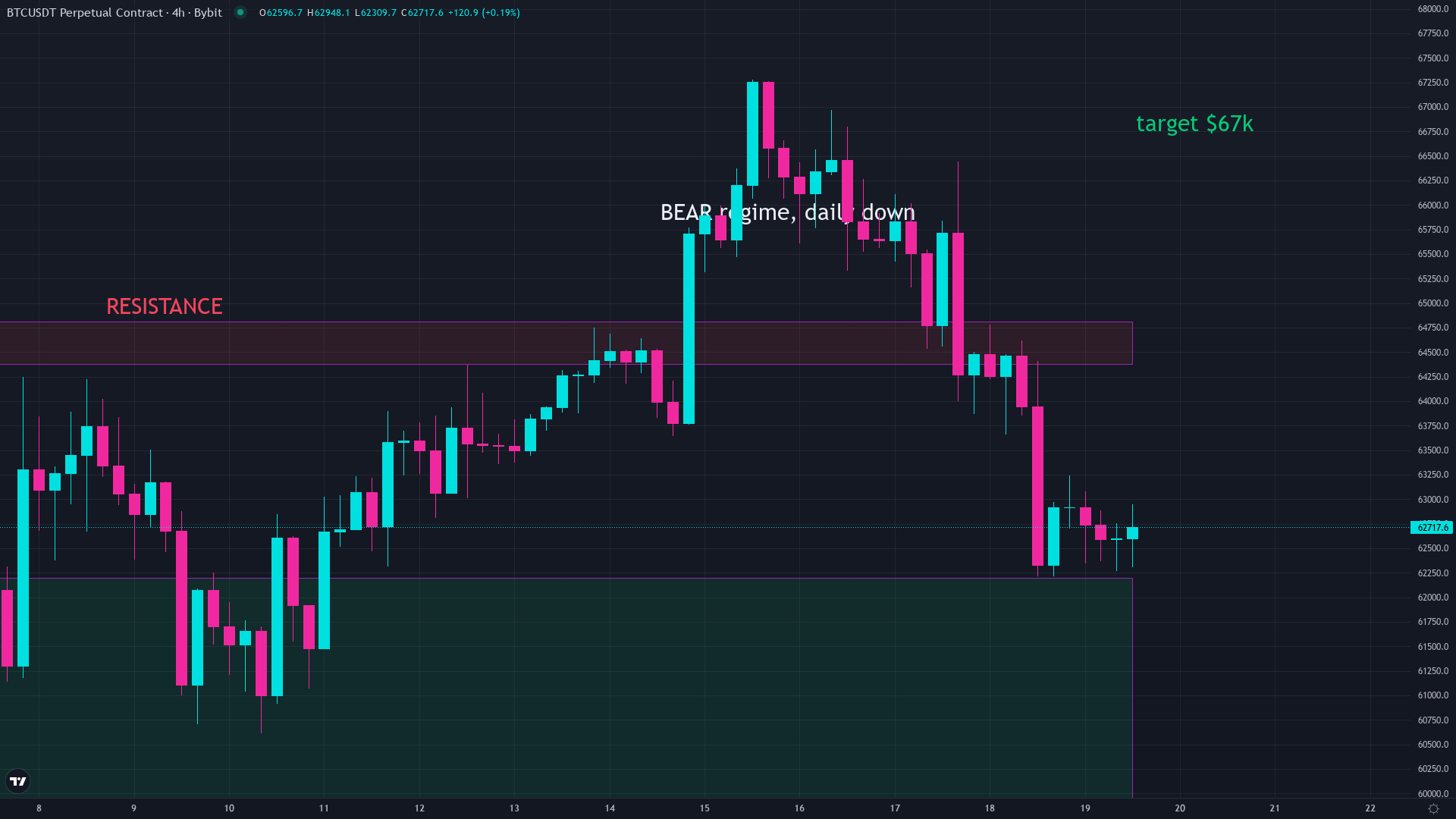
The most common way traders set a stop loss is the same way they pick a lucky number. They choose 2% because it sounds reasonable. Or 5% because they heard that somewhere. The number is almost never based on anything the market is actually doing.
That is the problem.
What a stop loss actually is
A stop loss is a pre-set price where your trade closes automatically. If you buy Bitcoin at $62,000 and set a stop loss at $61,000, your trade exits if Bitcoin drops to $61,000. You lose $1,000 per Bitcoin you held. No decision needed in the moment. No hoping it turns around.
The point is simple. You decide how much you are willing to lose before you enter the trade, not after price is already moving against you.
Why a fixed percentage stop loss usually fails
Here is the issue with picking a percentage at random. Bitcoin moves roughly 2% per day in normal conditions. Right now the expected daily range is about $61,261 to $64,009, a swing of nearly $2,750 just on a typical day.
If you set a 2% stop loss, you are drawing your line inside normal daily movement. Price does not need to go anywhere unusual to hit your stop. It just needs to be an ordinary day.
This is why so many traders get stopped out, then watch price reverse and go exactly where they expected. The stop was too tight. It was placed inside the noise, not outside it.
How to set a stop loss in crypto based on market structure
A better approach starts with the chart, not a percentage. You look for the closest level where, if price reaches it, you were clearly wrong about the trade.
For a trade where you are buying, that is usually the last visible low. A level where buyers showed up before and price bounced. A clear area of support. If price breaks below that point, the reason to be in the trade is gone.
That is where your stop goes, just below the level. Not right at it, because price often dips through briefly before reversing. You want to exit only when the level has actually broken, not from a quick wick.
Once you know where the stop is, you calculate how many coins to trade based on how much you are willing to lose on this one trade. If your stop is $1,000 away from your entry and you are willing to lose $100, you trade enough that a $1,000 move against you costs exactly $100. The size follows the stop. Not the other way around.
That is the actual order. Level first. Loss amount second. Size last.
The one risk number that changes everything
Across 109 live trades, every single trade risked 1% of the account and nothing more. The biggest single loss was capped at exactly what the plan said it would be. Not bigger. The loss stayed at the number decided before the trade opened.
The rule is straightforward. No single trade risks more than 1% of your account. If you have $5,000 to trade with, that is $50 at risk per trade. Not $500. Not “it depends how confident I feel today.”
The result after 109 trades at 1% risk: 70% win rate (excluding trades that closed at breakeven) and a total return of +34%. The stop loss made those numbers possible because it kept the losses small enough for wins to add up over time.
Without a plan-sized stop, one bad trade can erase weeks of profit.
Three stop loss mistakes that blow up accounts
- Moving the stop after entry. You set a stop at $61,000. Price drops to $61,200 and you tell yourself to give it more room. Now your stop is at $60,000. This is how small losses turn into large ones. The original stop was the plan. Moving it is how traders turn a capped loss into a real problem.
- No stop at all. Some traders skip the stop and plan to watch it closely. The market does not care about your schedule. A position with no stop becomes a bag the moment you step away from the screen. If you do not set a stop, you are not managing risk. You are hoping.
- Placing the stop inside normal movement. If Bitcoin typically swings $2,750 in a day and your stop is $300 away from entry, you will be stopped out over and over before price makes any real move. Wide enough to survive the noise. Tight enough that the loss stays small. That balance is the whole job.
If you want to see how not having a hard exit turns a bad day into a wipeout, the mechanics of crypto liquidation show exactly how that plays out at scale. And if you are wondering whether trading is even worth it while the market is falling, the numbers behind trading a crypto bear market might surprise you.
Common questions
What is a stop loss in crypto?
A stop loss is a pre-set price where your trade closes automatically. It means you decide the maximum you are willing to lose before you enter, not after the trade is already moving against you.
Where should I put my stop loss when trading Bitcoin?
Below the last clear support level or swing low on the chart. If price breaks that level, the reason to be in the trade is gone. Never place it inside the normal daily range where routine movement can hit it.
How much should I risk per crypto trade?
Most consistent traders risk 1% or less of their account per trade. At 1% risk, you can lose 20 trades in a row and still have most of your account. It keeps any single loss from doing real damage.
What happens if I trade crypto without a stop loss?
Without a stop loss you risk holding a losing position indefinitely. One trade with no exit can erase weeks of profit, and if you trade on leverage it can trigger a forced liquidation that wipes the account entirely.
Should I move my stop loss after a trade is open?
Never move it further away from your entry to avoid getting stopped out. Moving a stop to give a trade more room is how small losses turn into large ones. You can move a stop closer to lock in profit, but never wider.
Keep reading
We break down the market like this every day, free on Instagram and YouTube, and in depth inside the community.
Education, not financial advice. Trading involves real risk.