The Perfect Risk-Reward Ratio? I Ran 480,000 Simulations
Every trader has a favorite risk to reward ratio and defends it like a religion. 1 to 1, 1 to 2, 1 to 3. So I ran 480,000 simulations on 15 years of price action to find the perfect one. The answer is not a ratio. It is a cheat sheet, and it changes how you should think about every target you set.
A bigger reward always costs you wins
I ran the same trades at every ratio, from a tight 1 to 0.5 out to a greedy 1 to 5, with the risk held at 1 percent so nothing had an unfair edge. The first surprise was that every single ratio made money, all within a couple percent of each other. Because your reward is chained to something you do not control, your win rate.
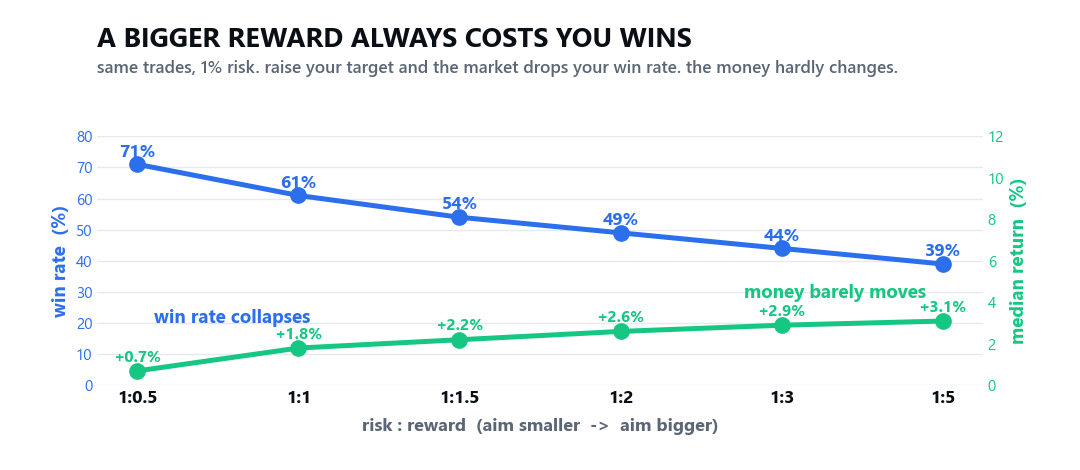
At 1 to 1 you won 61 percent of the time. Push out to 1 to 5 and you won just 39 percent. The money barely moved. The win rate fell off a cliff. You cannot have a high reward and a high win rate. The market makes you pick one.
So what are you actually choosing?
Not your profit. How often you win, and how the whole thing feels. A low ratio like 1 to 1 gives you a high hit rate and small, frequent wins. It feels steady. A high ratio like 1 to 3 gives you a 44 percent win rate and rarer, bigger wins. It feels like a grind punctuated by paydays. Same trades, about the same money, a completely different ride. Risk to reward is a personality choice, not a profit hack.
The high-reward trap
A big ratio looks like free money. At 1 to 5 you only need to win 17 percent of the time to break even, which sounds trivial. Do not fall for it. Your actual win rate falls just as fast, to under 40 percent, and that means long, brutal losing streaks. The math on a big ratio only works if you can survive the drought to collect the rare paydays, and most people cannot. They abandon the system in the middle of a losing streak, right before it pays. A ratio you cannot hold through a losing streak is worthless.
The only rule that matters
Forget the perfect ratio. Every ratio has a break-even win rate you must beat, and that single relationship decides whether your system is profitable or a slow bleed.
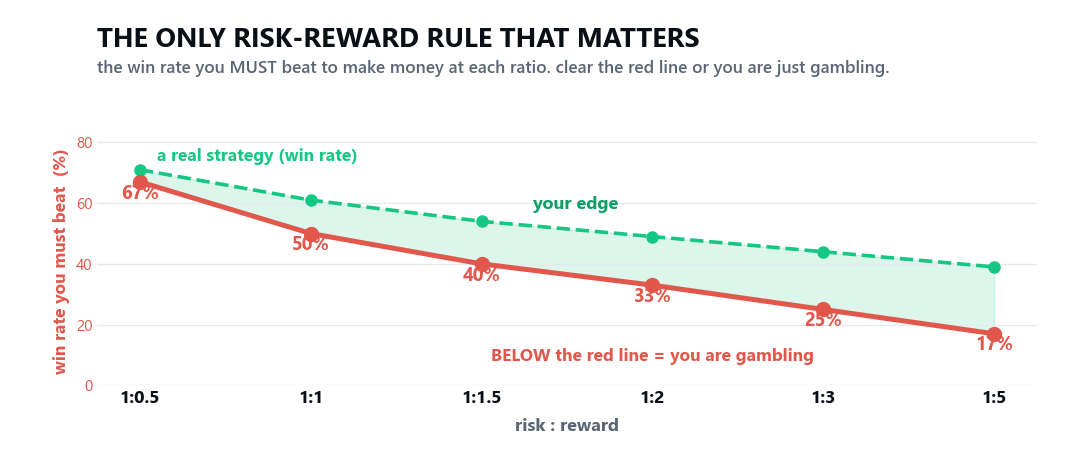
Clear the line and you have an edge. Miss it and you are gambling, no matter how good the ratio sounds. The break-even is pure math. It equals 1 divided by 1 plus the reward.
- 1 to 1 needs a 50 percent win rate
- 1 to 2 needs 33 percent
- 1 to 3 needs 25 percent
- 1 to 5 needs 17 percent
- 1 to 10 needs just 9 percent
How to use the cheat sheet
Do not start with a ratio. Start with your real win rate from your last 50 trades, not what you hope, what actually happened. Find your ratio and line it up against the break-even it demands. Your win rate must sit safely above that line, with a cushion for fees and variance, not just barely over it. And if it does not clear, change one thing, not both. Either pull your target in to a ratio your win rate can support, or fix the entry that is dragging your win rate down. Match the reward to your win rate, never the other way around.
I break down the market like this every day, free, on Instagram. To trade alongside me and the community, come to bitcoindaily.vip.
Educational, not financial advice. Every cycle is different and past performance is not a guarantee.
We break down the market like this every day, free on Instagram and YouTube, and in depth inside the community.
Education, not financial advice. Trading involves real risk.