How Correlated Are Altcoins to Bitcoin? (7 Years of Data)
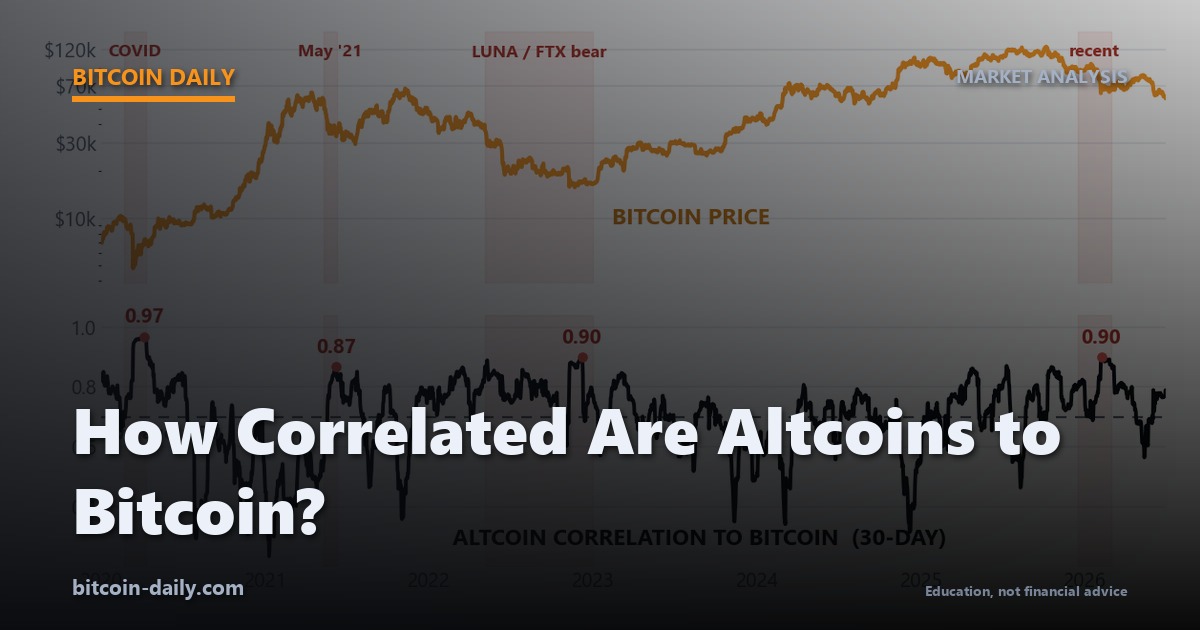
How correlated are altcoins to Bitcoin? It sounds like a technical question, but it quietly decides whether your crypto portfolio is actually diversified or whether you own one giant Bitcoin bet without realizing it. We pulled seven years of daily price data on the 11 biggest altcoins (ETH, BNB, XRP, ADA, SOL, DOGE, LTC, LINK, TRX, DOT, and AVAX) and measured it directly.
The short answer is that there is no single number. The correlation moves, and the way it moves is the whole story. In calm markets the average altcoin scores about 0.62. In every major crash it jumps toward 0.9. Altcoins give you independence in the good times and take it away the moment you need it.
What correlation actually means
Correlation is scored from 0 to 1. A score of zero means two assets move completely on their own. A score of 1.0 means they move in perfect lockstep. So when we say an altcoin has a 0.62 correlation to Bitcoin, it means the two usually move in the same direction, but the altcoin still has plenty of its own personality day to day.
Here is the part most people never check. Squaring that number tells you how much of the altcoin's daily movement is explained by Bitcoin. At 0.62, that is only about 38 percent. The other 62 percent is the coin's own story. That is exactly why holding a bag of different altcoins feels like real diversification when markets are calm. Most days, it genuinely behaves that way.
Every altcoin runs to Bitcoin in a crash
The daily average hides the truth. We scored each of the 11 biggest alts two ways. Once during calm markets, and once during the four major crashes of the last seven years (the COVID crash, the May 2021 collapse, the LUNA and FTX bear of 2022, and the current selloff).
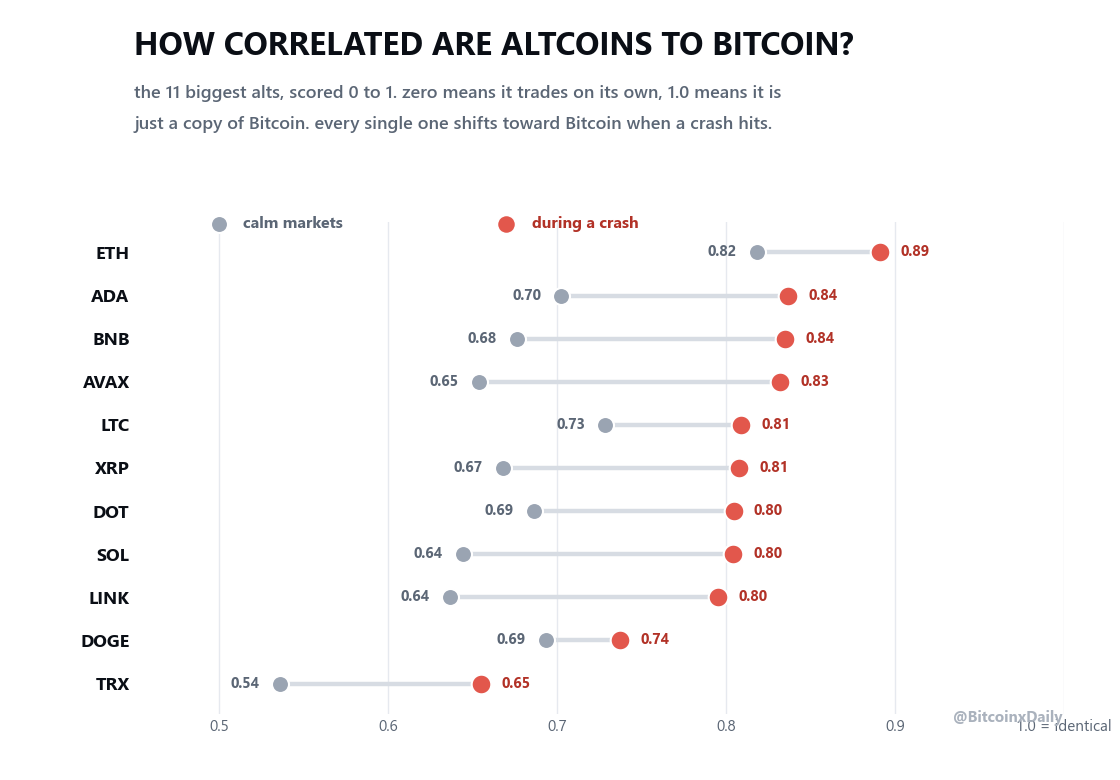
Every single coin shifts toward Bitcoin when a crash hits. Not most of them. All eleven. The basket average goes from 0.68 in calm markets to 0.80 in a crash. ETH tightens from 0.82 to 0.89. Cardano jumps from 0.70 to 0.84. Even TRX, the most independent coin in the group, climbs from 0.54 to 0.65.
Watch it happen in real time
This is the average altcoin's 30-day correlation to Bitcoin, drawn under the Bitcoin price. The shaded bands are the crashes.
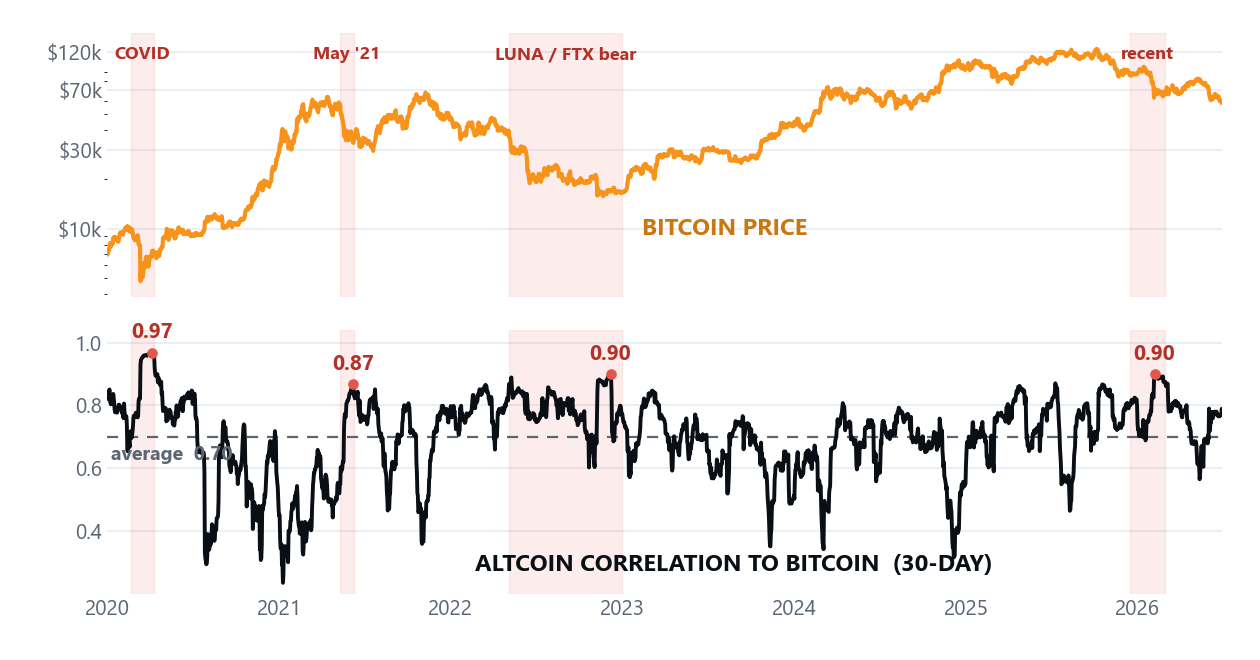
The pattern never breaks. The COVID crash pushed the average correlation to 0.97, which is close to a perfect copy. The 2022 collapse hit 0.90. The current selloff hit 0.90 again. The only stretches where altcoins truly decoupled from Bitcoin were the altseason melt-ups of DeFi summer 2020 and January 2021, when everything was pumping at once and the correlation briefly fell to around 0.25.
Read that again, because it is the core finding. Altcoins only break free from Bitcoin when they are going up. When Bitcoin bleeds, they line up behind it and bleed together.
They do not just follow Bitcoin down. They fall harder
Correlation only tells you they move together. It does not tell you the size of the move. Most altcoins carry what traders call a beta above 1, which means they amplify Bitcoin's swings in both directions. In this group, 8 of the 11 coins amplify Bitcoin, with a median of about 1.08.
You can see what that costs in a real bear market. As of mid-July 2026, Bitcoin sits about 48 percent below its 2025 peak. The average of these 11 altcoins is down about 70 percent. Polkadot is down 92 percent. Avalanche is down 88 percent. Cardano is down 87 percent.
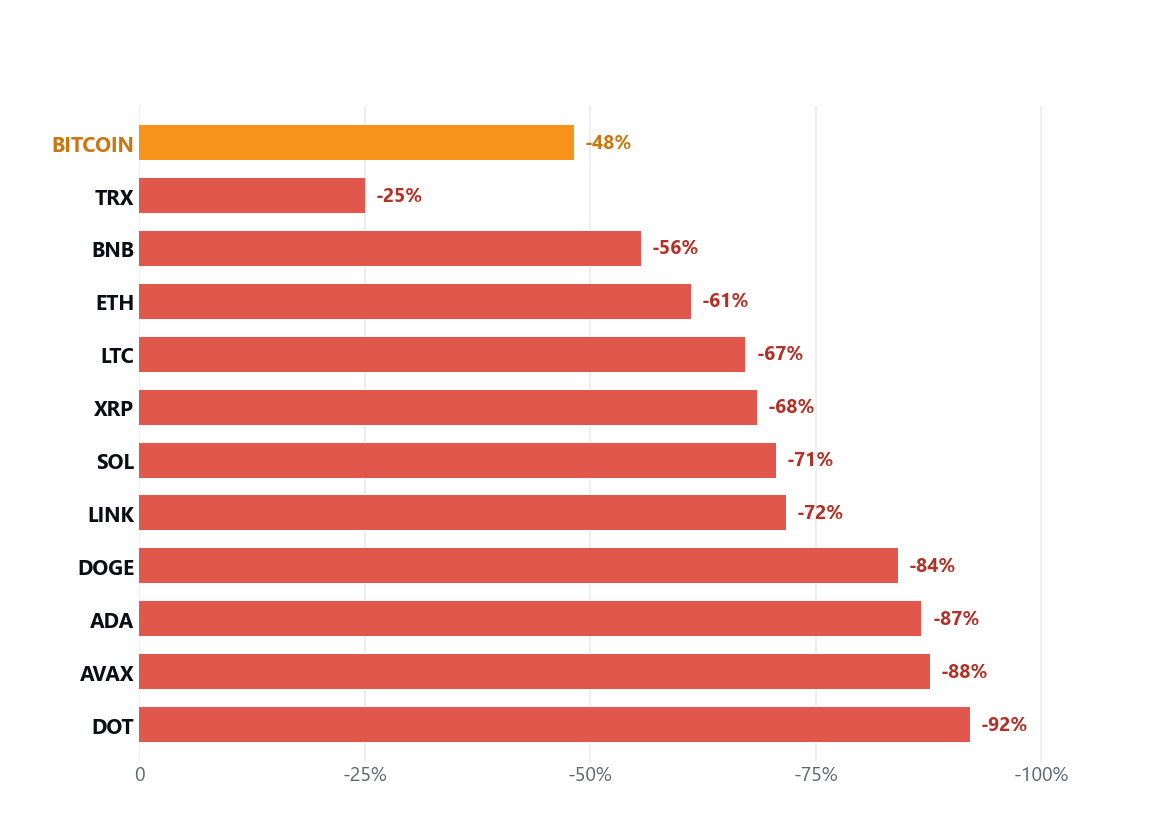
Holding more coins did not spread the risk. It amplified it. On Bitcoin's ten worst single days of the past seven years, the average altcoin fell 17.8 percent while Bitcoin fell 16.2 percent. Same crash, more damage.
The upside is not showing up either
For years, the deal with altcoins was simple. You accepted the bigger drawdowns because altseason would eventually pay for them. Last cycle, that deal quietly broke. Bitcoin ran to a brand new all-time high in 2025, and out of the top 17 altcoins from the previous boom, only 4 made a new high alongside it. ETH, BNB, SOL, and TRX. That is the whole list.
We wrote a full breakdown of why in What Happened To Altseason? The short version is that the number of coins exploded from about 440,000 in 2021 to over 20 million today, while the pool of money chasing them barely grew. The coordinated everything-moons altseason may simply not come back.
What this means for your portfolio
Put the two halves together. A bag of altcoins falls harder than Bitcoin in every crash, and last cycle it no longer reliably outran Bitcoin in the bull. That is not diversification. It behaves like one leveraged Bitcoin bet with a lottery ticket stapled on top.
The practical takeaway is about sizing. Count your entire altcoin bag as Bitcoin exposure, and then some. If you would not put 40 percent of your portfolio into Bitcoin, do not hold 40 percent in altcoins and call it something safer. And if you want the lottery ticket, treat it like one. A few alts really do beat Bitcoin each cycle, but picking them in advance is closer to a lottery than a plan.
To be clear, none of this says altcoins are worthless. ETH and SOL made new highs last cycle, and the right single pick can still outrun Bitcoin. The data simply says a basket of them does not protect you the way most people assume. This is education, not financial advice.
Get the full breakdown
We packaged the complete study into a free PDF. Every coin's correlation in calm markets versus crashes, the amplification numbers, the live drawdown table, the altseason scorecard, and a plain-English sizing framework. No email required. Read the free guide here, or browse the rest of our free guides.
Common questions
How correlated are altcoins to Bitcoin?
Over the last seven years, the 11 biggest altcoins show a median daily correlation to Bitcoin of about 0.62. But the number is not stable. In calm markets the basket averages around 0.68, and in every major crash it jumps to about 0.80 or higher, peaking at 0.97 during the COVID crash.
Do altcoins fall more than Bitcoin in a crash?
Yes. Most large altcoins amplify Bitcoin's moves. As of mid-July 2026, Bitcoin is down about 48 percent from its 2025 peak while the average large altcoin is down about 70 percent, and several are down more than 85 percent.
Does holding many altcoins diversify a crypto portfolio?
Not really. Day to day, altcoins look independent, but in every crash their correlation to Bitcoin rises toward 0.9 and they fall harder than Bitcoin. A basket of altcoins behaves like a single leveraged Bitcoin position, so it should be sized like one.
Keep reading
- What Happened To Altseason? (Bitcoin Made A New High And The Alts Didn't Follow)
- Is Bitcoin Correlated to Stocks? What the Data Says
We break down the market like this every day, free on Instagram and YouTube, and in depth inside the community.
Education, not financial advice. Trading involves real risk.