Bitcoin Runs on a Clock. The Research Paper
I just published my first official academic research paper on Bitcoin. It is called Bitcoin Runs on a Clock, it is live on SSRN, and it is completely free to read. This post is the plain English version of what it found.
The paper asks one question. Is Bitcoin's famous 4 year cycle real, or have we all been fooling ourselves for 15 years?
The famous tools decay
First I tested the indicators you see on your feed every week. Pi Cycle Top. MVRV. The Mayer Multiple. I checked whether their signals actually hold up across cycles, instead of just looking clever in hindsight.
They decay. Thresholds that nailed 2013 and 2017 have gone quiet or fired wrong since. The reason is simple. Every cycle's swings shrink. The 2011 to 2013 run multiplied your money about 532 times. The next run did 112x. Then 21x. The latest full run, from the 2022 bottom to the 2025 top, did about 7.9x.
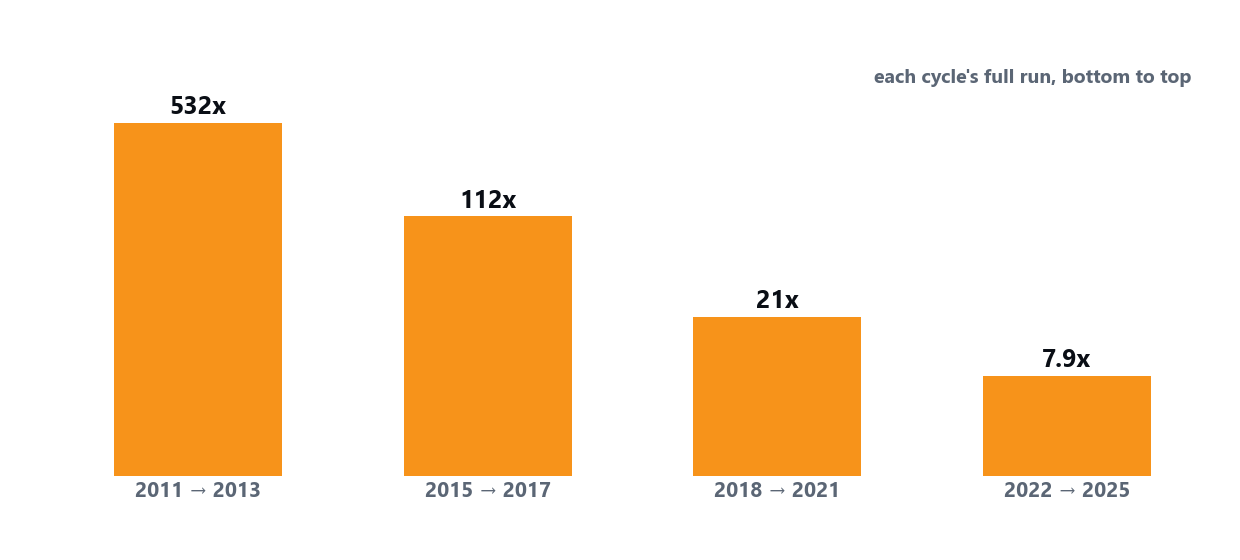
Any price threshold tuned to the old giant swings eventually stops working, because the swings it was tuned to no longer exist. When you run the strict statistics, none of the famous price indicators pass. Not some. None. The paper prints that plainly.
The clock does not
So the cycle is dead, right? This is where it got weird.
I stripped price out completely and asked a different question. Forget how big the moves are. When do the turns happen? Not how high. Not how low. Just the calendar.
The last three cycle tops in a row landed inside a narrow window around 18 months after the halving. Measured precisely, they came 525, 546, and 534 days after their halvings. The very first cycle top in 2013 came earlier, around 12 months, back when the market was tiny. The bottoms cluster on the calendar too.
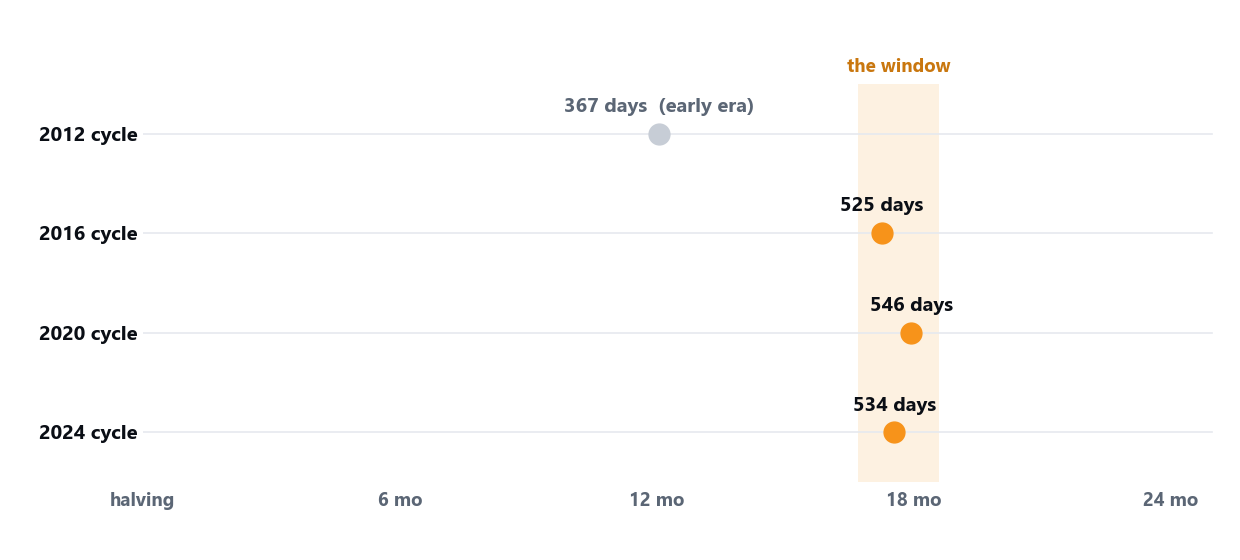
The swings shrink every cycle. The timing barely moves. Price ages. The calendar has not.
Could that be luck?
This is the part of the paper I care about most, because "it lines up" is exactly the kind of claim that fools people.
I built 10,000 random Bitcoin-like histories and counted how often the turn timing lines up this tightly by pure chance. The real Bitcoin's three modern tops sit only 21 days apart on the halving clock. In the main test, 0 out of 10,000 random histories locked their tops to the halving the way the real one does.
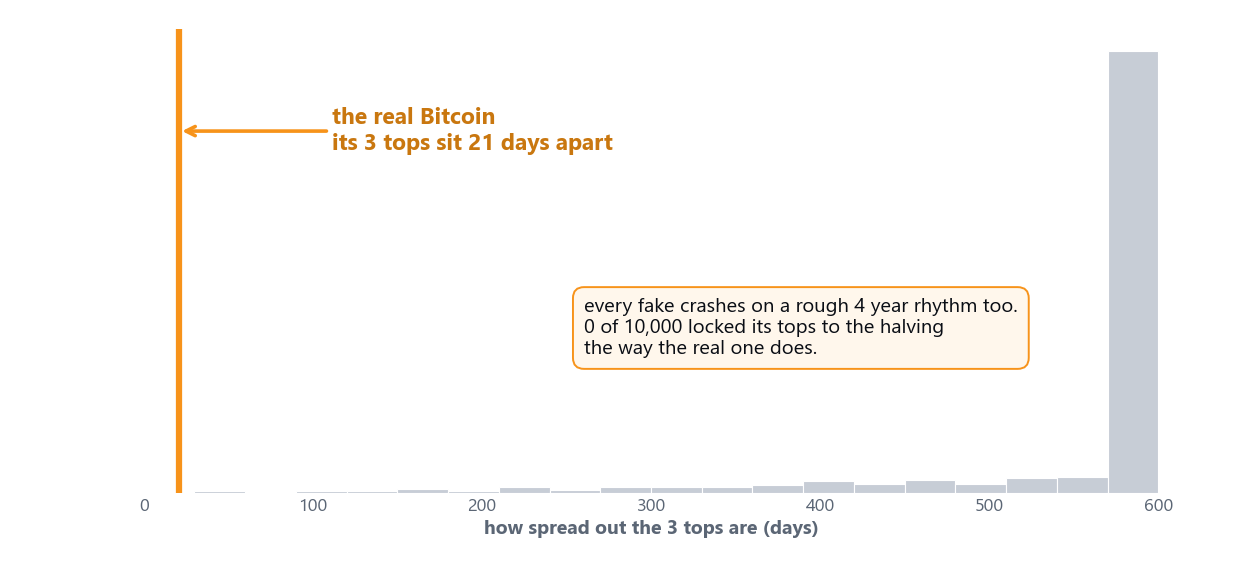
Very unlikely to be an accident.
The honest caveat
Bitcoin has completed 3 full cycles. That is a tiny sample, and tiny samples can fool careful people. The paper says that out loud instead of hiding it. Treat this as evidence, not prophecy.
The calls are public before they happen
Because the sample is small, the paper does the only honest thing left. It makes its next calls in advance, in public, where they can fail. The next bottom window and the next top window are pre registered and tracked live on this site, and nothing gets edited after the fact. You get to watch the clock work, or watch it break.
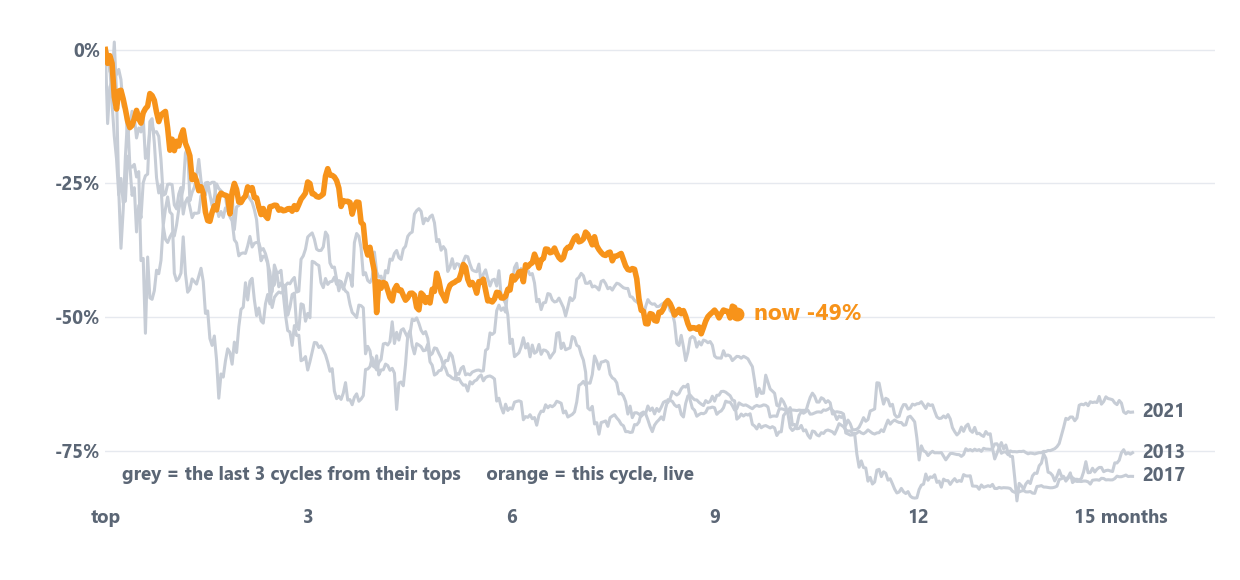
For context, this cycle is currently about 9 months past its October 2025 top and down roughly half, which sits inside the range of how past cycles behaved at this point on the clock.
Read it, rerun it, try to break it
The full paper is free. The data and the code are open. If you think something in it is wrong, I genuinely want to hear it. That is the point of publishing it.
I break down the market like this every day, free, on Instagram. To trade alongside me and the community, come to bitcoindaily.vip.
Educational, not financial advice. Every cycle is different and past performance is not a guarantee.
We break down the market like this every day, free on Instagram and YouTube, and in depth inside the community.
Education, not financial advice. Trading involves real risk.