What If You Bought Every Top 100 Altcoin at the Bottom? (3 Cycles of Data)
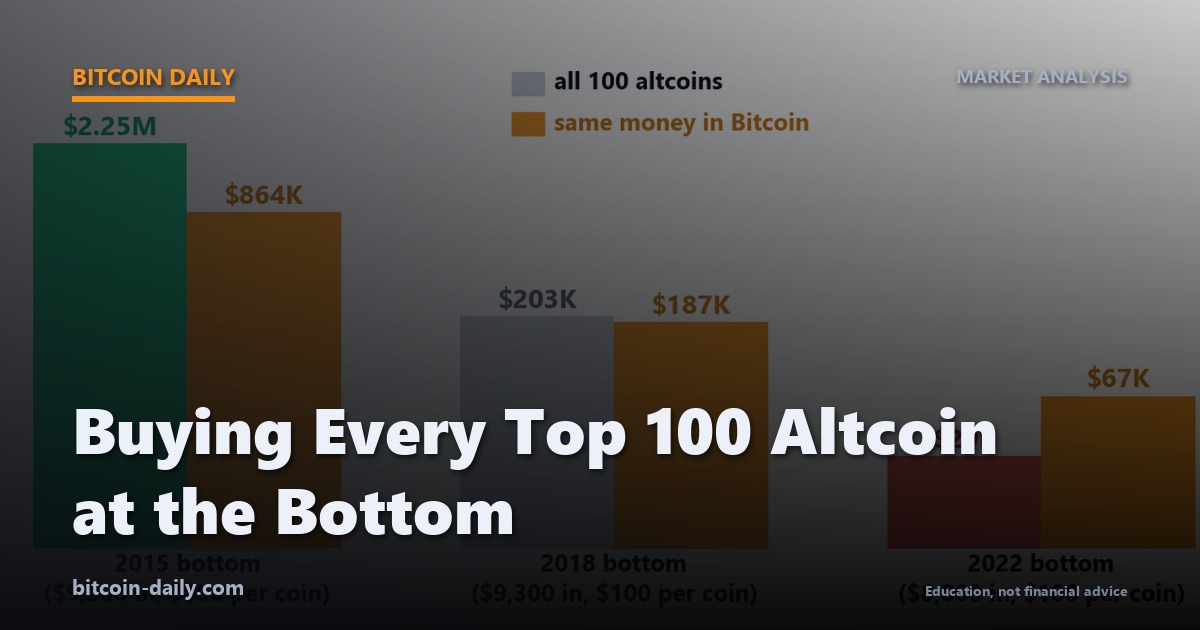
Every cycle, the same promise gets repeated. Buy altcoins at the bear market bottom, hold to the top, get rich. It is the most famous trade in crypto. So instead of arguing about it, I ran it, for real, across the last three bear market bottoms. This is what actually happened when you buy every top 100 altcoin at the bottom.
This article is the short version. The full breakdown, including the real reason altseason never came, is in the video above.
The experiment, and why most versions are fake
The test is simple. Put $100 into every coin in the top 100 at the exact bear market bottom, then sell each one at its best price of that cycle. Three bottoms: January 2015, December 2018, and November 2022.
The trick most people get wrong is survivorship bias. If you look at today's top 100 and trace it backwards, you only see the coins that survived. So I used point-in-time snapshots from CoinMarketCap, the actual top 100 as it stood on each bottom week, including every coin that later went to zero. A dead coin counts as a total loss, never quietly deleted. And every coin gets to sell at its own perfect peak. This is the trade at its absolute best case.
Cycle 1: 2015, the legend was real
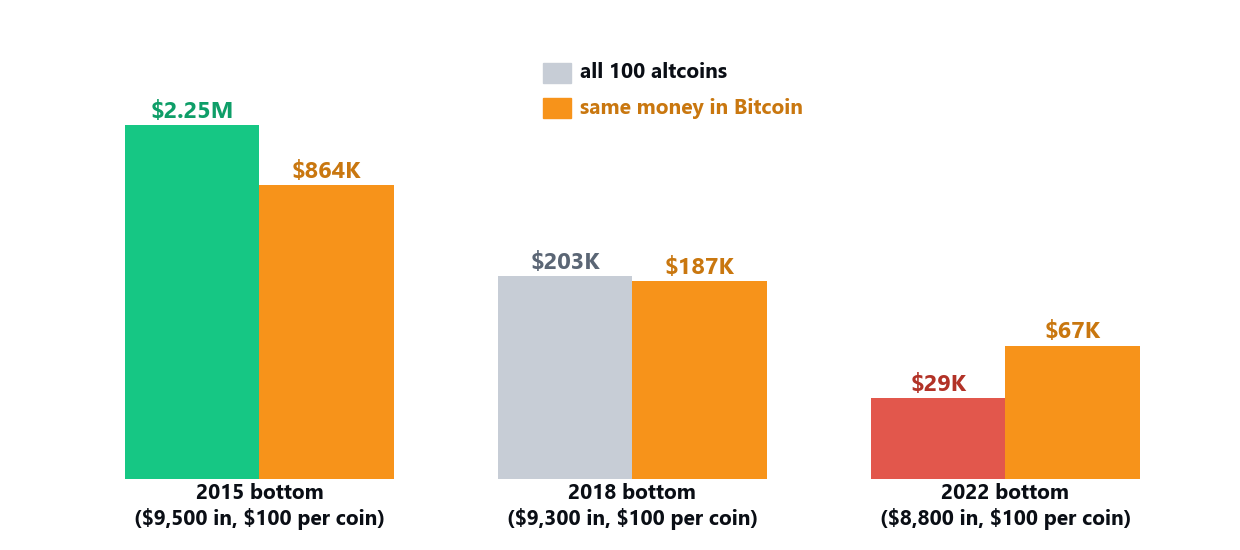
In January 2015, Bitcoin was around $200. You put $100 into each of the 95 investable coins in the top 100, so $9,500 total. By the 2017 peak, that basket was worth $2.25 million. The same money in Bitcoin alone made $865,000. The basket beat Bitcoin by two and a half times.
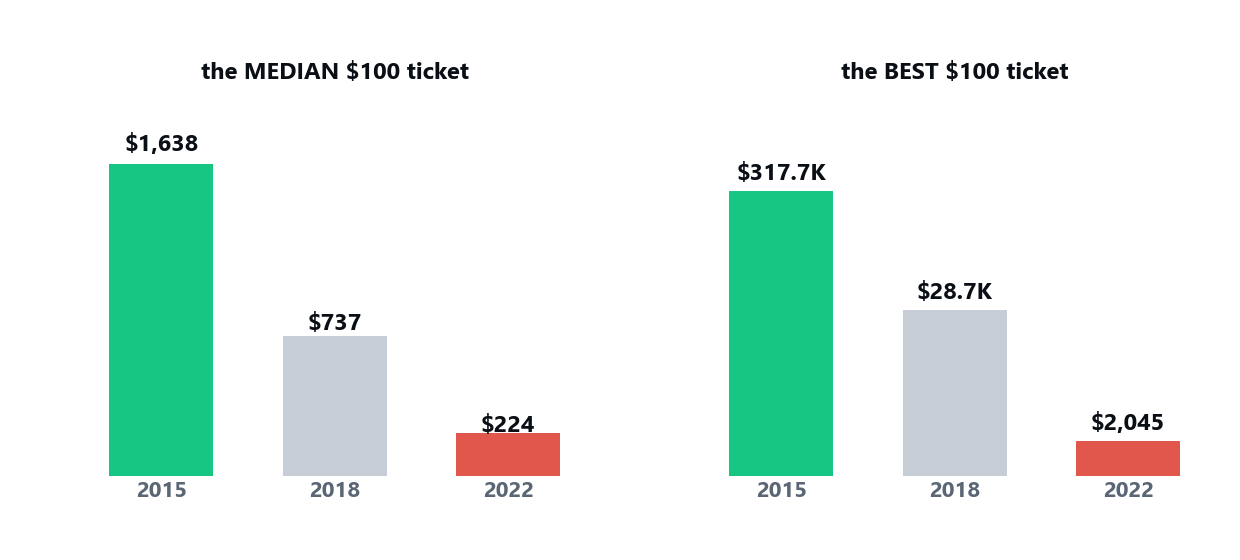
It gets crazier. 56 of the 95 coins did a 10x or better. One single $100 ticket, DigiByte, turned into $317,725. This is where the legend comes from, and in 2015 it was completely true.
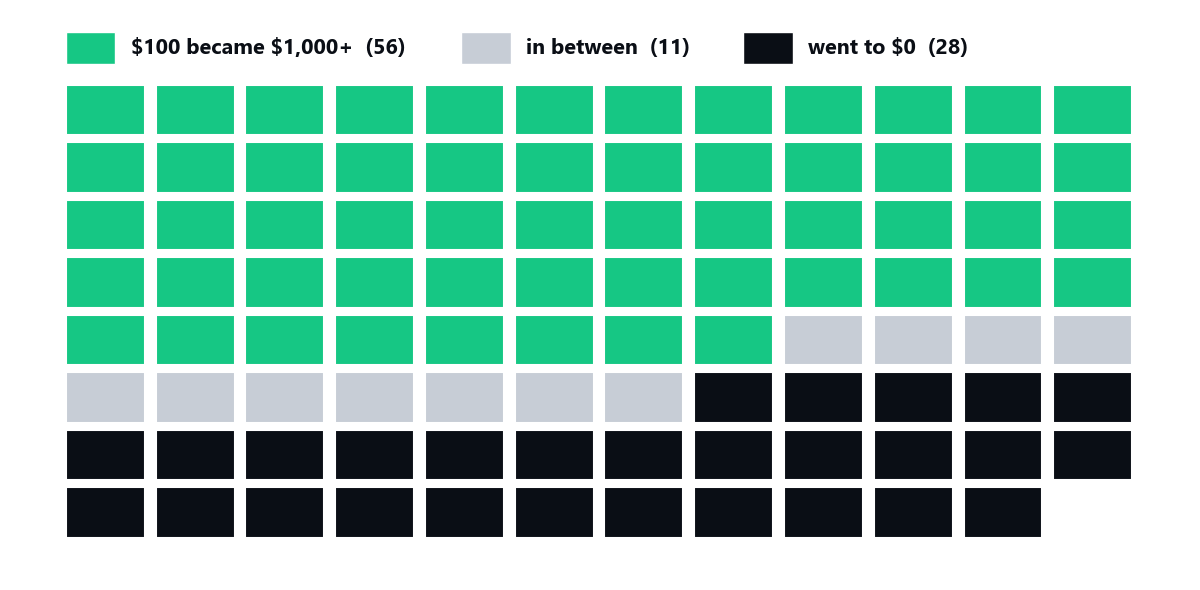
But read the fine print, because it was always a lottery. Even in that golden era, 28 of the 95 coins went to exactly zero, and only 29 of 95 actually beat just holding Bitcoin. A handful of jackpot tickets carried the entire basket. The lottery just used to pay.
Cycle 2: 2018, the edge fades
Same experiment from the December 2018 bottom. $9,300 across 93 coins became $203,000. Bitcoin alone made $187,000. Three years of holding 93 coins, many of them down 90 percent along the way, to beat the boring bet by a rounding error. The single best ticket shrank from $317,725 to $28,745. The edge was already dying.
Cycle 3: 2022, the experiment breaks
November 2022, the FTX collapse. Bitcoin at $16,292, peak despair, the textbook perfect bottom everyone claims they would buy with a time machine. So the experiment buys all 88 investable coins. By the 2025 top, that $8,800 became just $28,700. The same money in Bitcoin became $66,900.
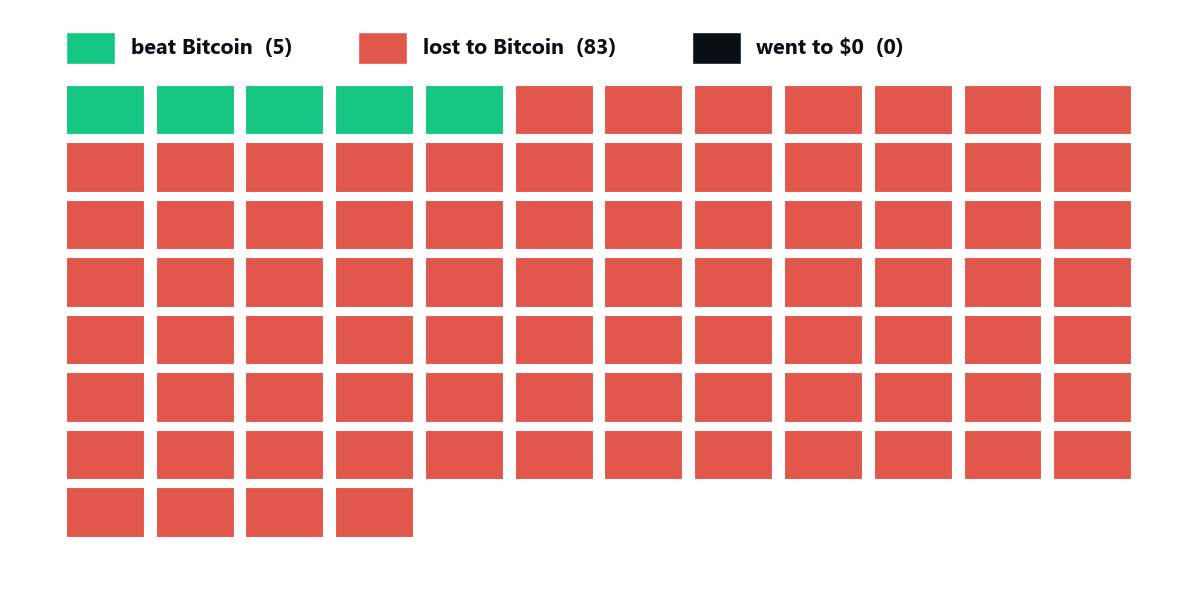
For the first time ever, buying every altcoin at the perfect bottom lost to simply holding Bitcoin, by more than two to one. Only 5 of the 88 coins beat Bitcoin. And the best ticket in the entire top 100 was Solana, which paid $2,045.
The trade is dying on a schedule
Line the three cycles up and the decay is not random, it is a straight line. The jackpot went $317,725, then $28,745, then $2,045. The median $100 ticket went $1,638, then $737, then $224. And the odds that any given altcoin beat Bitcoin from the bottom went 31 percent, then 16 percent, then 6 percent, cut in half every single cycle.
There is one more nail. If picking the right altcoin is the game, you would expect last cycle's winners to keep winning. They do not. Of the 15 coins that beat Bitcoin from the 2018 bottom, including Ethereum, zero repeated it from the 2022 bottom. Across all of crypto history, only 1 winner in 44 ever beat Bitcoin twice in a row. The rotation people are waiting for has no memory.
What this actually means
To be fair, lotteries have winners. Solana paid 20x last cycle, and three cycles is a small sample. Some ticket will always pay. But you cannot know which one in advance, last cycle's five winners sat at ranks 7, 16, 34, 71, and 88, scattered with no pattern. Buying the whole board no longer works, and no slice of it beat Bitcoin last cycle either.
The honest read from the data is simple. Bitcoin is the trade the numbers keep proving. Altcoins are a lottery that pays fewer people every cycle. This connects directly to two other things we measured: altcoins are basically leveraged Bitcoin on the way down, and the coordinated altseason that used to bail out alt bags may be structurally over.
The $100 experiment is only one of three studies. The full breakdown, the real reason altseason never came, and what I am actually doing about it with my own money, is in the new video here. This is education, not financial advice.
Common questions
What if you bought every top 100 altcoin at the bear market bottom?
Tested on 3 real bottoms, the result flips by cycle. From the 2015 bottom, $9,500 across the top 100 became $2.25 million and beat Bitcoin. From the 2018 bottom it barely edged Bitcoin. From the 2022 bottom it made $28,700 while the same money in Bitcoin made $66,900, losing badly for the first time.
Do altcoins beat Bitcoin from the bottom?
Less and less. The share of top-100 altcoins that beat Bitcoin from the bear market bottom fell from 31 percent in 2015, to 16 percent in 2018, to just 6 percent in 2022. Last cycle only 5 of 88 coins beat Bitcoin, and the best paid about 20x.
Do last cycle's altcoin winners repeat?
Almost never. Of the 15 coins that beat Bitcoin from the 2018 bottom, zero repeated it from the 2022 bottom. Across all of crypto history, only 1 winner in 44 has ever beaten Bitcoin from the bottom in two consecutive cycles.
Keep reading
- What Happened To Altseason? (Bitcoin Made A New High And The Alts Didn't Follow)
- How Correlated Are Altcoins to Bitcoin? (7 Years of Data)
We break down the market like this every day, free on Instagram and YouTube, and in depth inside the community.
Education, not financial advice. Trading involves real risk.