Hold Bitcoin for 4 Years: What the Data Shows
There are thousands of ways to lose money in Bitcoin. Buy the top, panic at the bottom, trade on leverage, follow a guru. But there is one thing that has never lost money in Bitcoin’s entire history. Hold for four years. Not a single person who bought Bitcoin and waited four full years ended up worse than where they started. That is not a guess. It is the complete record, every day, going back to 2010.
What happens if you hold Bitcoin for 4 years
Take every single day someone could have bought Bitcoin since it started trading. Now check the price exactly four years later. Every one of those windows is positive. All of them. The worst rolling four-year return in Bitcoin’s history was roughly +32%, from April 2021 to April 2025. That window started near the cycle peak, right when Bitcoin was above $60,000 and the whole market felt untouchable. Four years later, even that buyer was up about a third.
The best windows are absurd. Buy in 2011, check in 2015, and you are looking at thousands of percent. But even the boring ones, the unlucky ones, the ones where you bought on the single worst day of a cycle, still came out ahead.
Even the worst buyers ended up fine
Here is what makes this interesting. Bitcoin has had crashes of 50%, 73%, 84%, and 86% from peak to trough. Every single cycle has included a stretch that felt like the end. The 2014 crash took Bitcoin from about $1,150 to under $200. The 2018 crash took it from near $20,000 to about $3,200. The 2022 crash brought it from $69,000 to roughly $15,500 after FTX collapsed.
In each of those cases, if you bought at the absolute peak and simply waited four years, you were profitable. Not slightly. The December 2017 peak buyer who held until December 2021 saw Bitcoin around $47,000, more than double what they paid. The December 2013 peak buyer who held until late 2017 saw Bitcoin above $19,000, roughly 16 times their cost. The math keeps working because Bitcoin’s recoveries have, so far, always overshot the previous high.
Why four years matters
Four years is not a random number. Bitcoin goes through a roughly four-year cycle linked to the halving, which cuts the rate of new supply in half. Each cycle so far has followed a similar shape. A long, quiet accumulation phase. A sharp rally that overshoots. A painful crash that undershoots. Then a slow grind back up before the next halving resets the clock.
Four years is long enough to capture at least one full cycle. Short-term holders get caught in the crash phase and panic. Buyers who hold through four years ride through the worst of the crash and come out the other side during the next expansion.
One-year returns tell a completely different story. In any given 12-month window, Bitcoin is positive about 74% of the time. That means roughly one in four years, you would have been underwater at the one-year mark. Stretch it to four years and that number drops to zero.
The honest limits of this fact
Before you treat this as a guarantee, here is the part most people skip.
Past performance is just that. Fourteen years of data is a strong track record, but Bitcoin is still young compared to stocks, bonds, or gold. The sample covers only a handful of full cycles. It is possible, though unproven, that a future four-year window could break the streak. The market could face a regulatory shutdown, a technical failure, or a shift in adoption that changes the math.
The other catch is psychological. Holding for four years sounds easy on paper. In practice, it means watching your money fall 50% or more and doing nothing. Most people cannot do that. The 2022 crash wiped 78% off the peak in about 13 months. Sitting through that without selling requires a level of conviction that reading a statistic alone does not provide. If you want to understand how long Bitcoin bear markets actually last, the timeline helps set expectations.
Where we are right now
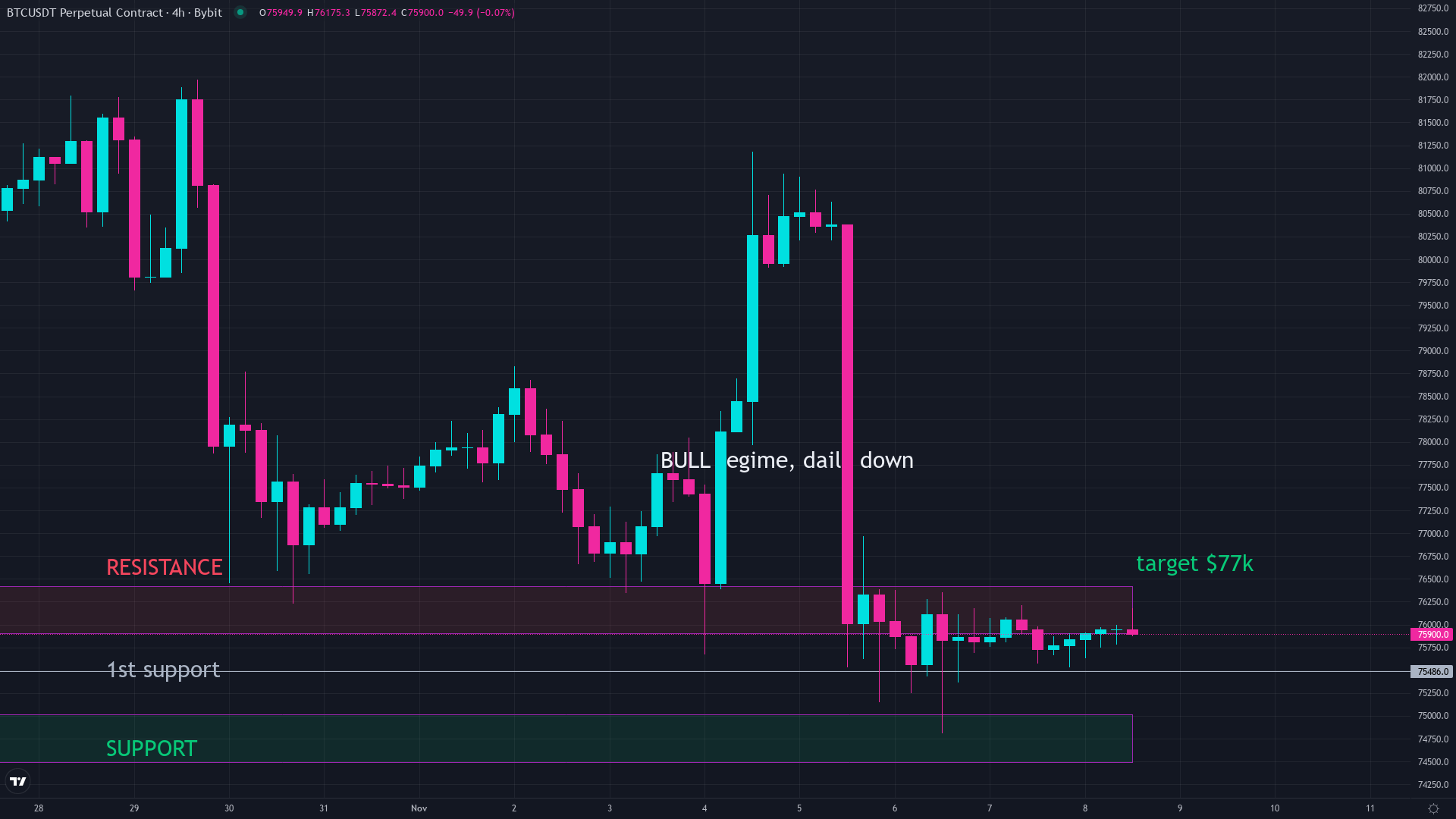
Bitcoin is trading near $75,900 as of November 2026, down roughly 40% from its all-time high near $126,000 set in late 2025. The Fear and Greed Index reads 28, firmly in fear. It feels bad. It is supposed to feel bad. That is what the accumulation phase of every past cycle has felt like.
Four years ago, in November 2022, Bitcoin was around $17,000. FTX had just collapsed. The Fear and Greed Index was in single digits. Every headline said crypto was finished. Anyone who bought that month and held until today is sitting on a return of roughly 350%. That is the pattern. The moments that feel worst to buy have historically produced the best four-year returns.
None of this is a promise that it will happen again. But the record is the record. Every four-year window. Every single one. Green.
Common questions
Has anyone lost money holding Bitcoin for 4 years?
No. Every rolling four-year window in Bitcoin history has ended with a positive return. The worst was roughly +32%, from April 2021 to April 2025.
What is the worst 4-year return for Bitcoin?
The worst rolling four-year return was about +32%, belonging to the window that started near the April 2021 peak and ended in April 2025.
Is 4 years long enough to hold Bitcoin?
Historically, yes. Four years captures at least one full cycle. One-year windows are positive about 74% of the time, but four-year windows have been positive 100% of the time so far.
Does holding Bitcoin for 4 years guarantee a profit?
It has worked every time in the past, but past performance does not guarantee future results. Bitcoin is still a young asset with only a handful of full cycles behind it.
What was Bitcoin worth 4 years ago?
In November 2022, Bitcoin traded around $17,000, shortly after the FTX collapse. A buyer at that price would be up roughly 350% as of November 2026.
Keep reading
We break down the market like this every day, free on Instagram and YouTube, and in depth inside the community.
Education, not financial advice. Trading involves real risk.