How Long Do Bitcoin Bear Markets Last?
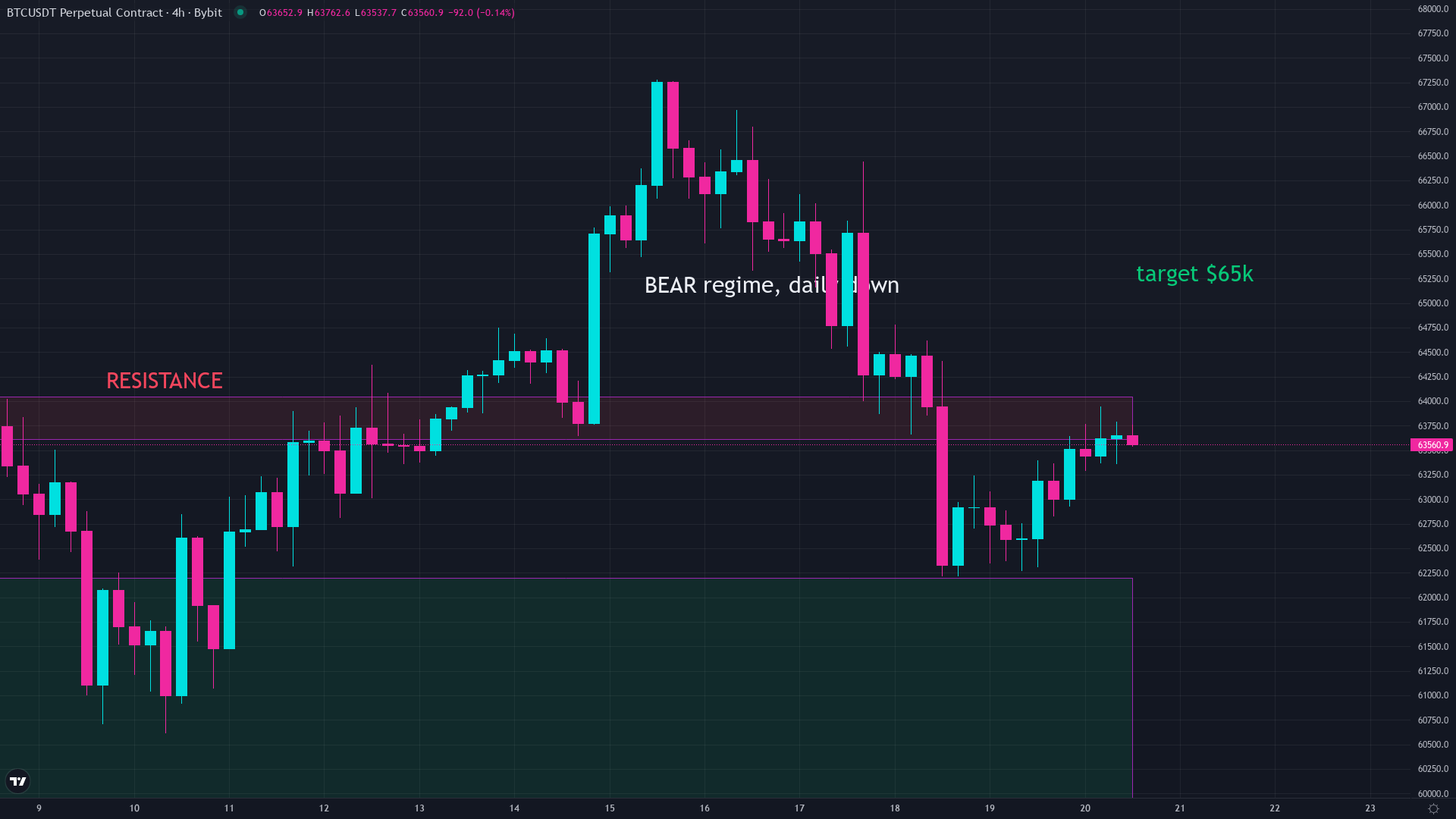
Bitcoin is down 50% from its October 2025 high of $126,000. It is sitting near $63,500 in a sea of negative funding rates and extreme fear. And the question every holder, every trader, and every person who bought the top is asking right now: how long do Bitcoin bear markets last?
Good news: we have the answer. Bitcoin has done this four times before. Every time, the crash looked like the end of the world. Every time, it was not. But knowing the pattern does not make the middle of it any less painful.
How long every Bitcoin bear market lasted
Here is the full history, peak to bottom:
- 2011: Bitcoin peaked at $32 and crashed 93%. The bottom came about 5 months later. Total recovery to a new high took roughly 20 months.
- 2013 to 2015: Bitcoin peaked near $1,150 and fell 86%. The crash portion lasted about 13 months before bottoming near $170 in January 2015.
- 2017 to 2018: Bitcoin peaked near $20,000 in December 2017 and bottomed at $3,200 in December 2018, exactly 12 months later, down 84%.
- 2021 to 2022: Bitcoin peaked near $69,000 in November 2021 and bottomed near $15,500 in November 2022. Another 12 months, down 77%.
See the pattern? The last three bear markets each lasted roughly 12 to 13 months from peak to bottom. The crashes got smaller each time (93%, 86%, 84%, 77%), and the recoveries got faster. That is not a coincidence. It is the market maturing.
Where we are right now: 257 days in
Bitcoin peaked at roughly $126,000 on October 6, 2025. Today is day 257 of this bear market, about 8 and a half months. The price is down roughly 50% from that high.
If the pattern holds, and this bear follows the same 12 to 13 month timeline, the bottom window falls somewhere around October or November 2026. That is another 3 to 4 months from here.
Nobody can guarantee the pattern repeats exactly. But four data points stretching over 15 years all saying roughly the same thing is hard to ignore. Especially when there is a structural reason the cycles rhyme: the Bitcoin halving happens every four years, cutting the supply of new coins in half, and every bear market has bottomed in the 12 to 18 months that follow.
How deep could this one go?
The crashes keep shrinking. 93%, then 86%, then 84%, then 77%. If you extend that trend, a 65% to 70% crash from $126,000 would put the low somewhere in the $38,000 to $44,000 range.
That is not a prediction. It is what history suggests if the shrinking pattern continues. The current 50% drop could already be most of the damage, or we could have another leg down. What the data does tell you: liquidation cascades tend to front-load the pain. The first 6 months are the violent part. The last few months before the bottom are a slow, boring grind where nobody wants to talk about Bitcoin anymore.
That boring phase is where smart money accumulates. But it does not feel smart at the time. It feels terrible.
Why Bitcoin bear markets keep happening
Every four years, the Bitcoin halving cuts the rate of new coins entering the market. That supply shock creates a bull run. The bull run creates hype. The hype pulls in over-leveraged buyers who chase the top. Then the music stops, those buyers get wiped out, and the price falls until the selling exhausts itself.
It is the same script every time. The characters change (Mt. Gox, ICOs, Luna, FTX), but the structure does not. Bitcoin goes up too fast, too many people borrow money to buy it, and then gravity does its job.
The encouraging part: each cycle, Bitcoin starts the next bull from a higher floor than the last. The 2018 bottom ($3,200) was higher than the 2013 top ($1,150). The 2022 bottom ($15,500) was higher than the 2017 top ($20,000 if you ignore the exact wick). Every bear market has felt like the end. None of them were.
What actually happens at the bottom
Bear market bottoms do not feel like bottoms. They feel like giving up. The Fear and Greed Index sits in extreme fear for weeks. Funding rates go negative, meaning short sellers are so confident that they are paying to hold their positions. Search interest for Bitcoin drops to multi-year lows. Crypto Twitter goes quiet.
Right now, the Fear and Greed Index reads 23, extreme fear. Funding is negative. Those are not bottom signals by themselves, but they are the ingredients. The bottom forms when the last forced seller has sold and there is nobody left to panic.
The takeaway
Bitcoin bear markets have lasted 12 to 13 months in the last three cycles. We are 8 and a half months into this one. The crashes keep getting smaller. The recoveries keep starting from higher floors. None of that makes the current pain fun, but it does put it in context.
If you are sitting in a 50% loss right now, you are not in uncharted territory. You are in the most well-documented pattern in all of crypto. The question is not whether it ends. It always has. The question is whether you are still here when it does.
Common questions
How long do Bitcoin bear markets last?
The last three Bitcoin bear markets each lasted roughly 12 to 13 months from peak to bottom. The current bear started in October 2025, putting us about 8 and a half months in as of June 2026.
How far does Bitcoin fall in a bear market?
Bitcoin has crashed 93%, 86%, 84%, and 77% in its four major bear markets. The drops keep getting smaller each cycle. The current drop from $126,000 is about 50% so far.
When will the Bitcoin bear market end?
If the 12 to 13 month pattern from the last three cycles holds, the bottom window falls around October or November 2026. No guarantee, but four consecutive cycles following the same rough timeline is hard to ignore.
What causes Bitcoin bear markets?
The four-year halving cycle cuts new supply, fueling a bull run that attracts over-leveraged buyers. When the rally exhausts itself, those buyers get wiped out and the price falls until selling dries up. The characters change each cycle, but the structure repeats.
Does Bitcoin recover after every bear market?
Yes. Every Bitcoin bear market has ended with a full recovery to a new all-time high. Each cycle has also started the next bull from a higher floor than the previous peak, meaning the long-term trend is up despite the crashes.
Keep reading
- Why Bitcoin Bleeds in the Summer (in a Bear Market)
- Crypto Liquidation Explained: What 272,000 Traders Missed
We break down the market like this every day, free on Instagram and YouTube, and in depth inside the community.
Education, not financial advice. Trading involves real risk.