How to Swing Trade Bitcoin (What Most Guides Leave Out)
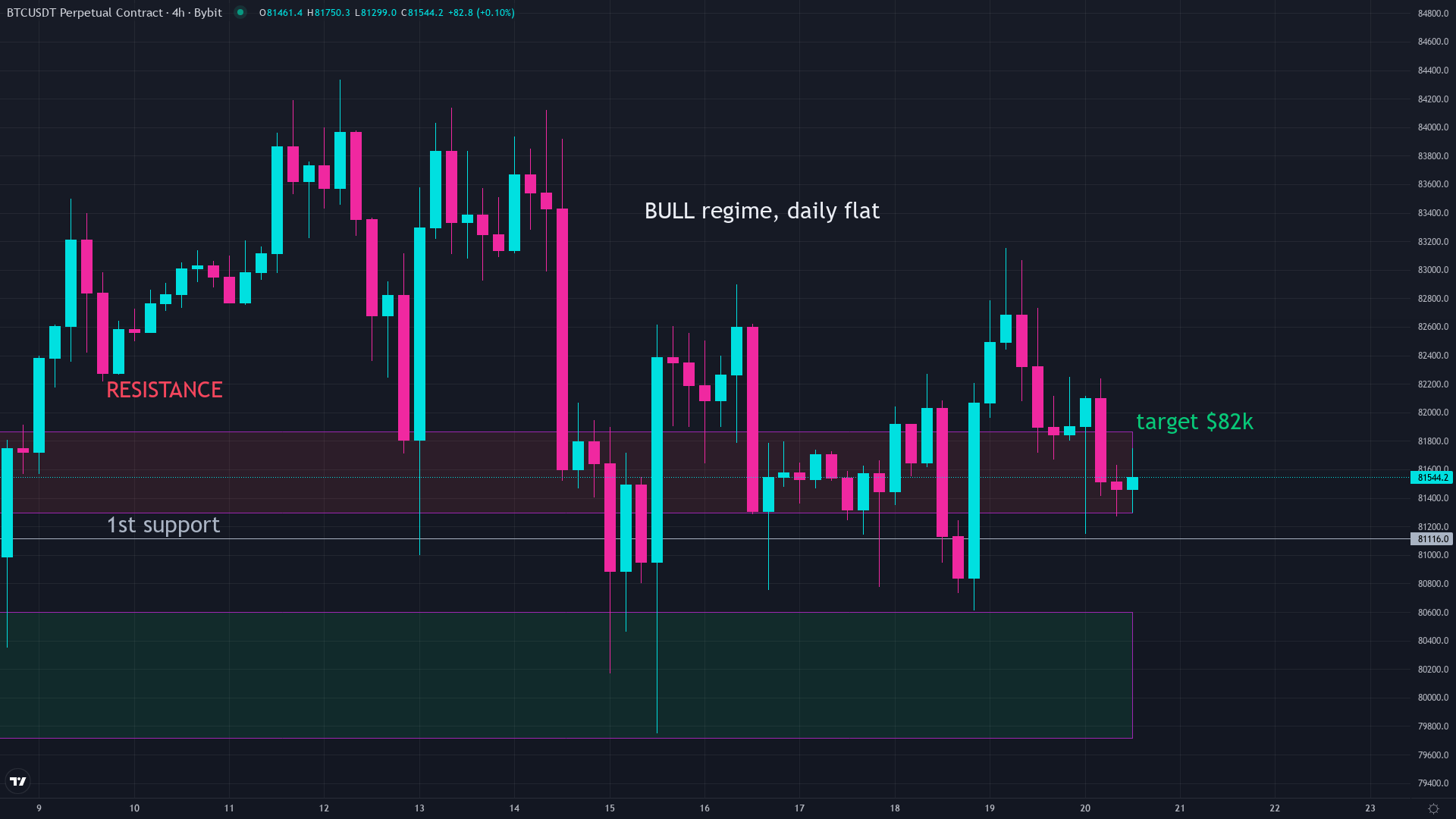
Most swing trading guides skip the part that actually matters. They’ll show you patterns and indicators, then quietly skip past what to do when a trade goes wrong. How to swing trade bitcoin is not about finding the perfect entry. It is about building a system you execute the same way every time. Here’s what that looks like.
What swing trading bitcoin actually means
Swing trading is holding a position for days or weeks rather than minutes or hours. You are not trying to catch every candle. You are looking for a bigger move, one with enough room to justify sitting through the noise in between.
The daily and four-hour charts are your maps. The five-minute chart is static. Most struggling swing traders are actually day traders who do not know it yet. They react to short-term noise and wonder why the trade fails even though the bigger picture still looks fine.
The rule of thumb for picking the right timeframe is simple: the timeframe you use should be far enough out that a normal one-hour move does not look like a signal. Fewer trades, cleaner decisions.
The setup filter that removes most bad trades
Here is the honest truth about swing setups: the ones that work look obvious in hindsight and murky in the moment. You will never have certainty before you enter. What you can have is a filter that cuts out the low-quality setups so the remaining ones have better odds.
Before placing a swing trade, ask two questions. First, is there a clear structural reason for price to move in this direction? A broken resistance level, a support that has held after several tests, a range that is getting tighter and tighter before breaking. You are looking for a reason, not a hope. Second, is there room to move before the next major level? If your target is only two or three percent away and there are three large resistance zones in between, the trade does not have space to breathe.
Most traders skip this filter because they are afraid of missing the move. The trades you do not take are often your best ones. Bitcoin sitting flat at $81,312 right at its 50-day average is not a clean swing setup. Waiting is a decision, and it is often the right one.
The risk rule that keeps every loss small
Position sizing is the part most guides bury at the back. It is actually the whole game.
The rule is simple: risk the same fixed percentage of your account on every single trade. The number I use is 1%. That means the most I can lose on any trade, if it hits my stop, is 1% of my account. Not what I hope to lose. The cap.
Here is how it works in practice. Say your account is $10,000 and you want to buy bitcoin at $81,000. You set your stop at $79,500 because that is where the setup breaks. The distance from entry to stop is $1,500. Your 1% budget is $100. So you buy roughly $100 divided by $1,500 worth of bitcoin. If it drops to your stop, you lose $100. If it hits your target, you make more. The position sizing guide walks through the full math.
After 109 real trades using this rule with a 70% win rate, no single losing trade ever threatened the account. The biggest loss was capped at 1R. That is what the rule is built to do.
Exits are where the edge actually lives
Most swing trading content obsesses over entries. Entries matter far less than traders believe. What actually determines your results is what you do after you are in. The plan for when to take profits. The rule for when to cut a loser. This is the part that separates traders who grow accounts from traders who spin their wheels for months.
For bitcoin swing trades: set your target at the next major resistance level before you enter. Once price reaches that level, close the trade or close most of it. Do not move the target lower because the trade is working. Cut losers at your stop, the exact level where the setup no longer makes sense. The full framework is in the bitcoin exit strategy guide.
The one mistake that costs most swing traders the most money
After 109 real trades, the most expensive mistake is not a bad entry. It is overriding the exit plan in real time.
Price is down half a percent and you tell yourself the setup is still valid, so you hold past the stop. Price is up one-and-a-half times your risk and you decide it can go to three times, so you stay past the target. Both of those decisions, made without a rule while watching the chart, eat into results slowly and invisibly. You barely notice until you look at the whole month.
The fix is to write the plan before you enter. Target level. Stop level. That is it. Once those two numbers are locked in before the trade opens, most of the emotional decisions disappear. You are executing a system, not reacting to candles.
A framework to start with
Open the daily chart. Mark last week’s high and low and the major areas where price has reversed before. Wait for price to react at one of those levels with real follow-through, not just a single candle. Size the position so your stop costs 1% of your account if it triggers. Set your target at the next significant level. Execute the plan without changing it mid-trade.
Indicators and signal tools sit on top of this foundation. Build the foundation first. Most traders add more tools to avoid the work of building the system underneath. The system works without almost any of the tools. Almost none of the tools work without the system.
Common questions
What is the best timeframe for swing trading bitcoin?
The daily chart gives the cleanest structure for most swing traders. The four-hour chart adds precision for entry timing. Staying off short timeframes like the five-minute chart removes noise without removing signal.
How much money do you need to swing trade bitcoin?
You can swing trade with any account size as long as you size correctly. The rule is to risk 1% per trade. A $1,000 account risks $10 per trade. Position size adjusts to match that number no matter the account size.
Is swing trading bitcoin profitable?
It can be. A 70% win rate with 1% risk per trade and a reward greater than the risk grows an account over time. The challenge is not the math, it is following the plan consistently enough for the math to play out.
What indicators do swing traders use for bitcoin?
Support and resistance levels, moving averages, and volume are the most common. No indicator is required to swing trade profitably. What is required is a fixed risk rule, a clear entry filter, and a written exit plan.
How long do bitcoin swing trades typically last?
Most bitcoin swing trades last two days to two weeks. A trade running much longer than that has usually either hit its target or stopped out long before.
Keep reading
We break down the market like this every day, free on Instagram and YouTube, and in depth inside the community.
Education, not financial advice. Trading involves real risk.