Stablecoin Supply and Bitcoin: Does Dry Powder Predict Price?
Every few weeks someone posts the same chart. A mountain of digital dollars, a caption about dry powder, and a promise that all that cash is about to pour into Bitcoin. It sounds airtight. More dollars parked inside crypto should mean more buying. So I tested it. I took every day since 2020, measured how stablecoin supply had changed over the month before, and checked what Bitcoin did next. The popular half of the story mostly fell apart. The half nobody posts held up.
What stablecoin supply actually measures
A stablecoin is a crypto token built to stay worth one dollar. Tether and USDC are the two biggest. When someone sends real dollars to the company behind one, new tokens get created. When someone cashes out, tokens get destroyed. Stablecoin supply is simply the total of those dollar tokens in existence.
Picture a casino. Bitcoin and altcoins are the chips on the tables. Stablecoins are the chips people have pulled off the tables but have not walked out the door with yet. That pile of waiting money is what traders call dry powder. It is one of the forces I covered in what drives Bitcoin’s price, and it is the one people misread the most.
Does stablecoin supply predict Bitcoin’s price?
Here is the test. I sorted every day since 2020 by how total stablecoin supply had changed over the prior 30 days. Then I asked one plain question. Was Bitcoin higher a month later?
On an ordinary day the answer is yes about 55% of the time. That is the bar to beat.
- Supply grew more than 3% in a month. Bitcoin was higher a month later 55% of the time. Exactly the ordinary odds.
- Supply sat flat. Bitcoin was higher a month later 44% of the time.
- Supply shrank more than 3% in a month. Bitcoin was higher a month later only 40% of the time. Two months later it was 35%, and the typical result was a loss of about 8%.
Read the first line again. The famous bullish signal, a fast-growing pile of dollars, gave you the same odds as a random day. The reading that actually moved the odds was the opposite one. A pile that is shrinking fast.
The middle is messy, and I am not going to hide that. Small moves in either direction, a gain or a loss of 1% to 3%, both came with slightly better than ordinary odds. There is no clean staircase here. That alone tells you this is a loose signal and not a crystal ball.
Why growing stablecoin supply is not a buy signal
Two reasons, and both are simple.
First, the dollars arrive late. When I lined the two up, stablecoin supply and Bitcoin mostly moved in the same month. Supply did not move first. New money shows up after Bitcoin has already rallied, because rallies are what pull people in. By the time the mountain looks impressive, the move that built it has already happened.
Second, cash on the sidelines does not have to buy anything. Chips off the table can go back on the table. They can also go out the door. A big pile tells you how much money is in the building. It does not tell you which way it is about to walk.
What shrinking stablecoin supply has meant
A shrinking pile is different, because it is not a guess about what people might do. It is a record of what they already did. Tokens only get destroyed when someone cashes out to real dollars and leaves.
The clearest example is May 2022. A large stablecoin project called Terra collapsed, trust cracked, and holders rushed to cash out of Tether. Its supply dropped by about a fifth over the following weeks. Bitcoin was near $29,000 when that drain began. Six months later it was about 36% lower.
Now the honest other side. Not every dip is 2022. Since 2020, Tether’s supply has slipped 3% below its record six times. In five of those six, Bitcoin was higher three months later. Small dips that stopped quickly were mostly noise. The deep, fast drains were the ones that hurt.
Where stablecoin supply stands now
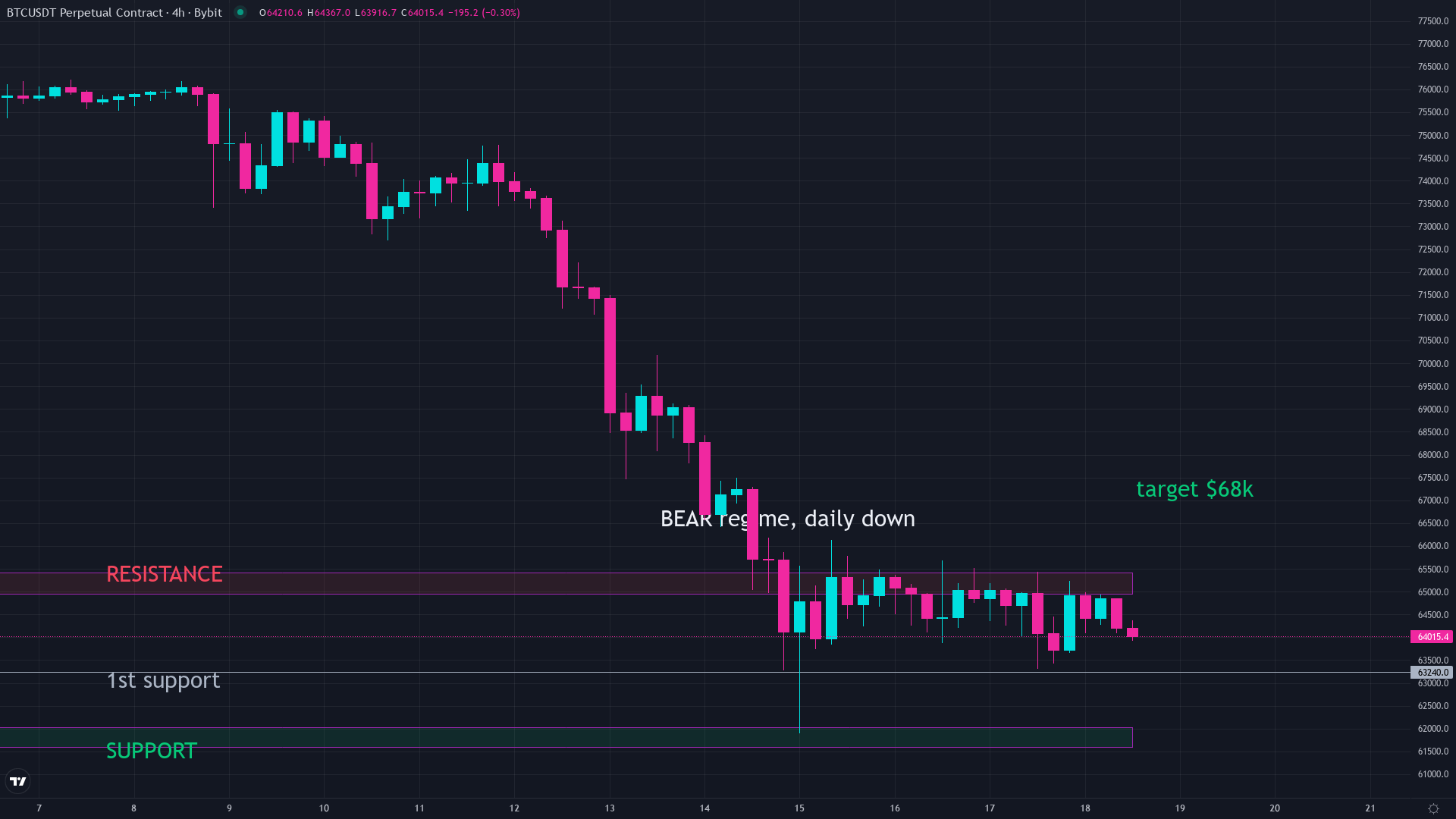
As of mid-November 2026, total stablecoin supply is about $286 billion. That is roughly 8% below the record near $313 billion set in May 2026, and it has fallen about 5% in the last 30 days alone. That puts today squarely in the worst group in the test. Bitcoin has dropped about 22% over the same month and trades near $64,000.
I will not dress that up. Right now money is leaving the building, not waiting in the lobby. It is the same story you see when Bitcoin ETFs see outflows. A different door, the same direction.
It is not a forecast either. Supply tends to follow price, so part of this drain is simply the echo of the fall that already happened. The thing worth watching is plain. Does the pile stop shrinking? In the past, that was the point where the odds drifted back to ordinary.
The takeaway on stablecoin supply and Bitcoin
- Stablecoin supply is the pile of digital dollars sitting inside crypto. It grows when money comes in and shrinks when money cashes out.
- A fast-growing pile has not been a buy signal. Since 2020 it gave the same odds as any ordinary day.
- A fast-shrinking pile has been a real caution flag. Bitcoin was higher a month later only 40% of the time.
- Small dips are usually noise. Deep, fast drains are the ones to respect.
One last warning from the guy who ran the numbers. Six years is a short history, and many of these days overlap. Treat the percentages as a lean, not a law. The next time someone shows you a mountain of dry powder and calls it rocket fuel, ask the better question. Is the mountain growing, or is it quietly getting smaller?
Common questions
What is stablecoin supply?
It is the total number of dollar tokens like Tether and USDC in existence. It grows when people send real dollars into crypto and shrinks when they cash out.
Does stablecoin supply predict Bitcoin price?
Only loosely. Since 2020, fast-growing supply gave Bitcoin the same odds as an ordinary day, while supply shrinking more than 3% in a month left Bitcoin higher a month later only 40% of the time.
Is rising stablecoin supply bullish for Bitcoin?
Not on its own. New stablecoins mostly show up after Bitcoin has already rallied, and cash on the sidelines can leave just as easily as it can buy.
What does falling stablecoin supply mean?
It means people cashed out to real dollars and left. Small dips have mostly been noise, but deep, fast drains like the one in May 2022 came before more downside.
How much stablecoin supply is there right now?
About $286 billion as of mid-November 2026, roughly 8% below the record near $313 billion set in May 2026.
Keep reading
- What Drives Bitcoin's Price? (The 5 Forces)
- Bitcoin ETF Outflows Explained: What They Mean for Price
We break down the market like this every day, free on Instagram and YouTube, and in depth inside the community.
Education, not financial advice. Trading involves real risk.