Why Is Bitcoin Going Up? The 3 Forces Behind Every Rally
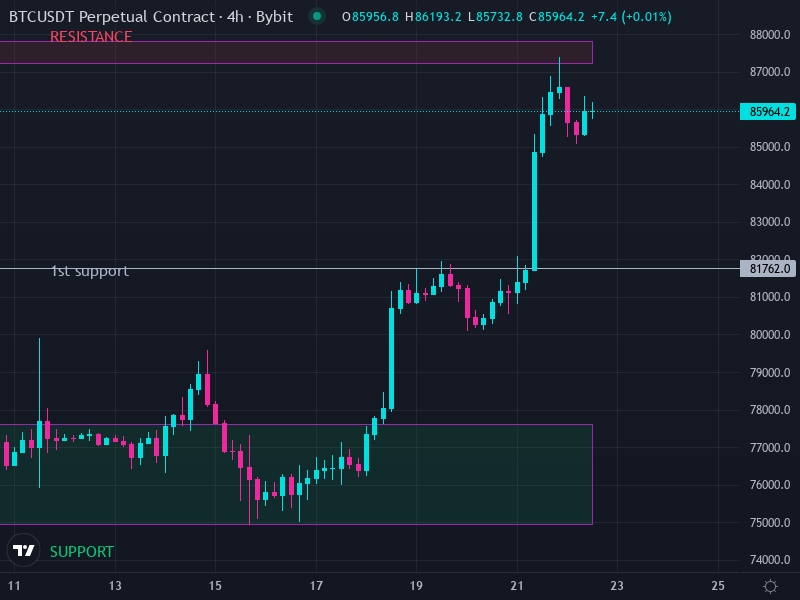
Why is Bitcoin going up? Every time BTC rips 10% or more in a week, the same question floods Google. And every time, the headlines give you a different reason. Last week it was the Fed. The week before it was ETFs. Before that, someone blamed a whale. The truth is simpler than any of those stories, and it repeats every single cycle.
Bitcoin is up about 13% in seven days, sitting near $86,000 for the first time since January. The Fear and Greed Index reads 78, deep into “Extreme Greed.” Funding rates are in the 96th percentile for the year, meaning leveraged longs are paying through the nose to stay in. The mood shifted fast. But mood is not an explanation. Here are the three engines that actually move BTC higher, and which one matters most right now.
Engine 1: Big money flowing in through ETFs
Spot Bitcoin ETFs in the U.S. pulled in roughly $999 million on September 21 alone. Over the past three weeks, net inflows topped $3.8 billion. That is real money from pension funds, advisors, and institutions buying Bitcoin the same way they buy the S&P 500: one click, no wallet, no keys.
When ETF inflows run hot, they create steady buying pressure that the market cannot ignore. The ETFs now hold over $103 billion in combined assets, roughly 6% of Bitcoin’s total market cap. Every dollar that flows in must be matched by an actual Bitcoin purchase on the open market. That is not hype. It is plumbing.
This is a structural shift that did not exist before 2024. In older cycles, rallies were fueled almost entirely by retail traders on exchanges. Now the biggest single buyer on any given day might be BlackRock’s IBIT fund, which alone absorbed over $381 million on September 21. If you want to understand what drives Bitcoin’s price, ETFs are now a permanent part of the answer.
Engine 2: Short squeezes, the gasoline on the fire
A short squeeze is what happens when traders bet against Bitcoin and the price goes up anyway. Their brokers force them to buy back their positions at a loss, which pushes the price up even faster, which forces more shorts to close. It is a chain reaction.
On September 21, roughly $648 million in short positions got liquidated in 24 hours. More than $262 million of that vanished in a single hour as BTC crossed $84,000. Picture a crowded theater where everyone rushes for the same exit at once. That is what a short squeeze looks like on a price chart: a near-vertical green candle that moves faster than any fundamental news could justify.
Short squeezes do not start rallies. They accelerate them. The initial push comes from somewhere else (usually Engine 1 or Engine 3), and the squeeze pours gasoline on it. This is why Bitcoin often moves 5% in a day when the news only justified 1%.
Engine 3: The cycle doing what it always does
Bitcoin has followed a roughly four-year pattern since it was born. It crashes hard, sits at the bottom long enough to convince everyone it is dead, then recovers in a way that looks impossible until you realize it has done the exact same thing three times before.
Right now, BTC is about 351 days past its cycle high. That puts it in the late stage of the correction, historically the part where the market starts to turn before most people believe it. The four-year cycle is not a guarantee. But every time someone declares it dead, the pattern shows up again.
This is the engine most people miss because it operates on a timeframe that feels too slow. ETFs move in days. Squeezes move in hours. The cycle moves in months and years. But it is the one that sets the stage for everything else. ETF inflows accelerate when the cycle turns. Shorts pile up because the cycle spent a year grinding lower. Then both engines fire at once, and the result is weeks like this one.
So which engine is doing the work right now?
All three, but the order matters. The cycle put Bitcoin in a zone where it was cheap relative to its own history. That attracted ETF money, which created steady upward pressure. The upward pressure liquidated shorts, which created the explosive moves. It is a sequence, not a coincidence.
Here is the part most people get wrong: they see the squeeze and think that is the story. It is not. The squeeze is the firework. The ETF flow is the fuse. The cycle is the calendar that told you firework season was coming.
None of this means Bitcoin goes straight up from here. Extreme Greed readings (the index is at 78 today) have historically preceded pullbacks, sometimes sharp ones. Funding rates in the 96th percentile mean the market is paying a premium to be long, and crowded trades tend to unwind painfully. If you want to understand how Bitcoin crashes work, the setup often looks exactly like this: euphoria, leverage, then a flush.
But the bigger picture is not about this week. It is about recognizing that Bitcoin rallies are not random. They are three engines firing in a specific order, and once you see the pattern, the next one will not surprise you.
Common questions
Why is Bitcoin going up right now?
A combination of heavy ETF inflows (nearly $1 billion on September 21 alone), a short squeeze that liquidated over $648 million in bearish bets, and Bitcoin entering the late stage of its historical four-year cycle where recoveries typically begin.
Do Bitcoin ETFs actually move the price?
Yes. Every dollar of ETF inflow requires an actual Bitcoin purchase on the open market. With U.S. spot ETFs holding over $103 billion in assets, they are now one of the largest sources of daily buying pressure.
What is a short squeeze in crypto?
A short squeeze happens when traders betting on lower prices get forced to buy back their positions as the price rises, creating a chain reaction of buying that pushes the price up even faster.
Does the Bitcoin four-year cycle still work?
No pattern is guaranteed, but Bitcoin has followed a roughly four-year boom-and-bust rhythm in every cycle since its creation. The current cycle timing is consistent with the late correction phase where past recoveries have started.
Should I buy Bitcoin when it is going up this fast?
Fast rallies feel exciting but often come with elevated risk. The Fear and Greed Index is deep in Extreme Greed territory and leverage is high. Historically, those conditions have preceded short-term pullbacks even within larger uptrends. This is education, not financial advice.
Keep reading
We break down the market like this every day, free on Instagram and YouTube, and in depth inside the community.
Education, not financial advice. Trading involves real risk.