Bitcoin vs the Dollar: Does a Weak Dollar Help BTC?
If you spend five minutes on crypto social media, someone will tell you that the dollar going down means Bitcoin goes up. They will say it like it is a law of physics. And right now, with the Dollar Index sitting below 100 for the first time in months, that crowd is loud again.
They are not entirely wrong. But the version they are selling is dangerously simple, and dangerous simplicity is where most people lose money.
What the Dollar Index actually measures
The Dollar Index (DXY) tracks the U.S. dollar against a basket of six other currencies: the euro, yen, pound, Canadian dollar, Swedish krona, and Swiss franc. When the number goes up, the dollar is getting stronger relative to those currencies. When it goes down, the dollar is weakening.
Think of it as a scoreboard. It does not tell you what anything costs. It tells you whether the dollar is winning or losing against its peers. A DXY at 100 means the dollar is roughly where it was when the index was created. Below 100, it is weaker than that baseline. Above 100, stronger.
The pattern that makes everyone confident
Here is why the crowd sounds so sure. In March 2020, the DXY was sitting around 103. By January 2021, it had fallen to 89. During that same stretch, Bitcoin went from roughly $4,000 to over $60,000. Dollar down, Bitcoin up. The textbook played out perfectly.
Then the opposite happened. In 2022, the Federal Reserve started raising interest rates at the fastest pace in decades. The DXY surged from the low 90s all the way to 114 by September 2022. Bitcoin fell from about $47,000 to below $16,000. Dollar up, Bitcoin down. The textbook again.
Two clean examples. Two cycles. If you stopped there, you would walk away thinking this is the easiest trade on the planet.
Why does a weak dollar help Bitcoin?
The logic is real, even if the execution is harder than it looks. When the dollar weakens, three things tend to happen at once.
- Borrowing gets cheaper. A weak dollar usually means the Fed is cutting rates or printing money, or both. Cheap money pushes people into riskier bets, and Bitcoin is one of the riskiest bets on the board.
- Global buyers get a discount. If you are sitting in Europe or Japan and the dollar drops 10%, Bitcoin just got 10% cheaper in your currency without the price moving at all. That pulls in foreign demand.
- Capital leaves the safe room. A falling dollar means investors are moving out of dollar-denominated safe assets (like Treasury bonds) and into things that might grow faster. Bitcoin, gold, and stocks all tend to benefit from that same rotation.
So yes. A weak dollar creates a tailwind for Bitcoin. That part is true. The problem is what happens when people treat a tailwind like a guarantee.
When the relationship breaks
In early 2024, Bitcoin rallied hard while the dollar was stable. Spot ETF approvals in the United States flooded billions of new dollars into BTC, and the dollar barely moved. The old inverse playbook said nothing should have happened. Instead, Bitcoin more than doubled.
There are also periods where both the dollar and Bitcoin fell together. That happens during genuine panic, like the March 2020 crash itself, when everything sold off before the recovery began. In a real liquidity crunch, the nice inverse chart goes out the window because people are selling whatever they can to raise cash.
The average historical relationship between the dollar and Bitcoin sits at roughly minus 0.58. In plain language, they move in opposite directions more often than the same direction, but they agree about 40% of the time. That is not a coin flip, but it is not a lock either.
Where we sit right now
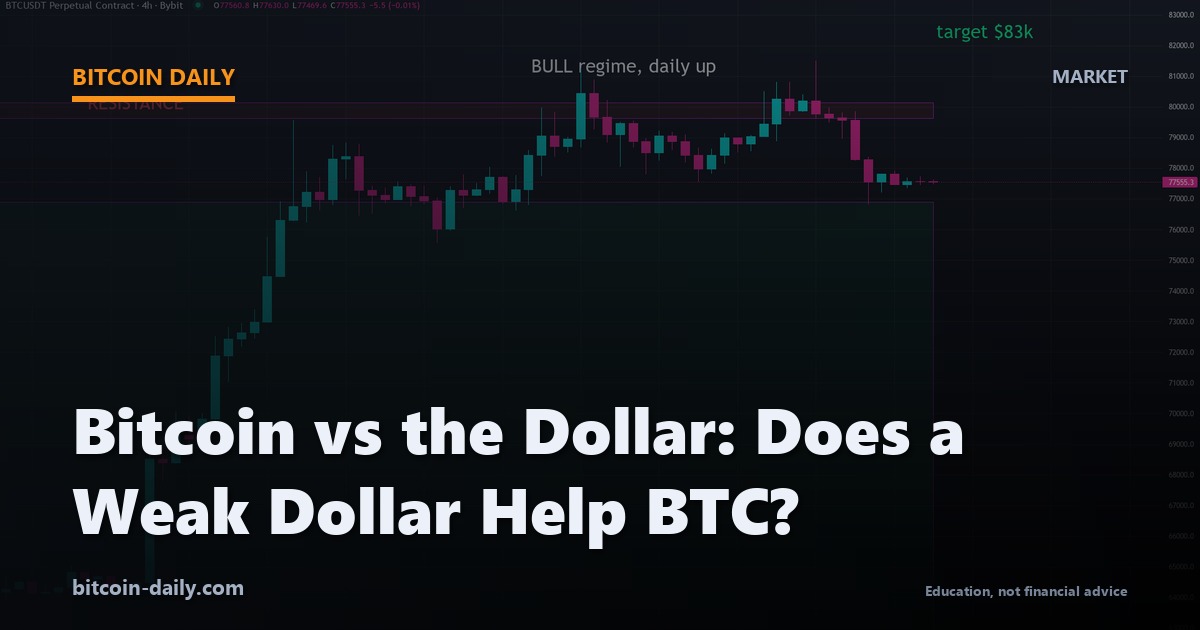
The DXY is near 100, having drifted lower through the summer. Bitcoin is at roughly $77,700, up sharply from the July low near $57,700. The Fear and Greed Index reads 68 (greed). The dollar weakness and the Bitcoin bounce are rhyming with the historical pattern.
But here is the honest framing. Bitcoin is also up 38% from its recent low while the historical bear-market rally median peaked at about 35%. A falling dollar helped fuel this move. Whether it can sustain it depends on why the dollar is falling, not just that it is.
If the dollar is weak because the economy is strong enough to handle it and the Fed is loosening, that is the good version. If the dollar is weak because something is breaking, that is 2020 all over again, and the first chapter of that story was a crash, not a rally.
The takeaway
- A weak dollar creates conditions where Bitcoin tends to do well. The pattern has repeated across multiple cycles and it is real.
- It is not a trigger. Bitcoin has rallied without the dollar falling (2024 ETF wave) and crashed alongside the dollar in panic selloffs. Treat the DXY as context, not a buy signal.
- The reason the dollar moves matters more than the direction. Rate cuts into a soft landing and rate cuts into a crisis produce very different outcomes for everything, including Bitcoin.
Common questions
Does a weak dollar help Bitcoin?
Yes, historically. A falling dollar makes borrowing cheaper, gives foreign buyers a discount, and pushes capital out of safe assets into riskier ones like Bitcoin. But the pattern is not a guarantee and breaks during liquidity crises.
What is the Dollar Index (DXY)?
The DXY tracks the U.S. dollar against a basket of six major currencies. When it rises, the dollar is strengthening. When it falls, the dollar is weakening relative to those peers.
Does Bitcoin always go up when the dollar goes down?
No. They move in opposite directions more often than not, but they agree about 40% of the time. ETF-driven rallies and panic selloffs can break the pattern entirely.
What happened to Bitcoin when the dollar hit 114 in 2022?
Bitcoin fell from about $47,000 to below $16,000 as the Fed raised rates and the DXY surged to a 20-year high. The strong dollar crushed risk appetite across every market.
Keep reading
We break down the market like this every day, free on Instagram and YouTube, and in depth inside the community.
Education, not financial advice. Trading involves real risk.