How to Set a Stop Loss in Crypto (Without Getting It Wrong)
Out of 109 live crypto trades, my biggest single loss was exactly one unit of risk. Not two. Not five. One. Every time.
That did not happen because I picked perfect entries. It happened because I did one thing before every trade that most traders either skip entirely or do wrong: I set a stop loss in crypto before I clicked buy. A real one, tied to a real level, before emotion was involved.
Most people treat the stop loss as an afterthought. As protection in case things go bad. The data says that thinking is backwards. The stop loss is not your seatbelt. It is the entire blueprint for the trade.
What a stop loss in crypto actually does
A stop loss answers one question before you enter any trade: how much of my account am I willing to lose if this is wrong?
That question sounds simple. Most traders answer it wrong. They think about how much pain feels manageable, not about what the chart is telling them. They pick a round number like $500, or 5% below their entry, or some figure that came from their gut.
The market does not care about your gut. It cares about levels. A stop that is not tied to a real level on the chart gets hit randomly, even on trades that would have worked if given a proper anchor.
The two ways traders set stops wrong
Too far. “I’ll just give it room.” This usually comes from fear of getting stopped out right before the trade works. But giving extra room means every loss is bigger. Run this pattern across 30 trades and a handful of bad ones can wipe out a full month of gains.
Too tight. “I’ll put it just below my entry price.” Normal market movement stops you out before the trade has a real chance. You re-enter at a worse price. You get stopped again. Both mistakes feel rational in the moment. Both cost real money over time.
How to set a stop loss in crypto the right way
Here is the method that works:
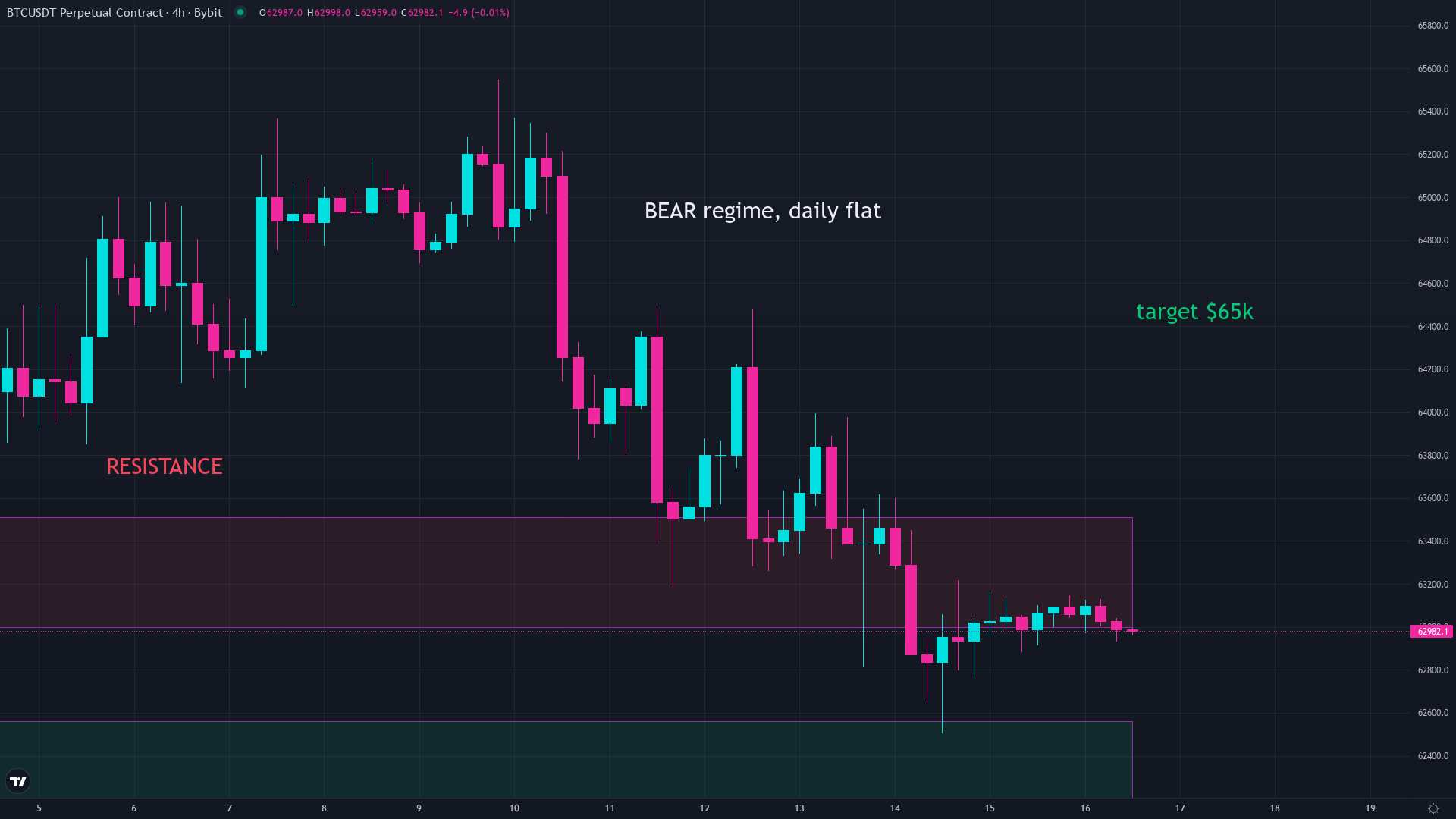
- Find the level that would prove you are wrong. A major area of price support that breaks cleanly, the low of a range that gets taken out, the line the chart should not cross if your read is correct. That is your stop. Not a number you invented. A level the market itself gave you.
- Measure the distance from your entry to that level. If your entry is $63,000 and the level that proves you wrong is $62,000, your distance is $1,000 per coin.
- Size your position so that distance equals a fixed percentage of your account. I use 1%. If losing $1,000 on the trade equals 1% of my account, I have the right position size. The stop and the size both come from the chart, not from feelings.
This is what turns a stop loss from a random cut-off point into the foundation of every trade. Once you build this habit, the entry, the exit, and the size all flow from one question: where does the chart prove me wrong? For a deeper look at pairing this with smart target levels, see how to think through position sizing in crypto and what the numbers say about the right risk-to-reward ratio.
Why 1% risk per trade keeps traders in the game
At 1% risk per trade, you could lose 20 trades in a row and still have about 82% of your account left. Most traders would quit before trade 10. But at 1% you are still in the game, still learning, still improving.
That math sounds boring. Boring is the point. Boring is what keeps you alive long enough to get good at this. The traders who blow up are almost always the ones who decided that 1% was for people who lacked confidence in their picks.
Across 109 live trades, my biggest single loss never went past 1R, one unit of risk. That is not luck. That is what happens when the stop is set before the trade, and you do not touch it after emotions kick in.
The one rule that makes all of this work
Set your stop. Write it down. Then do not widen it to avoid taking the loss.
Moving a stop further out to dodge being wrong is just borrowing the loss from the future. The trade that should have ended at 1% becomes 3%, becomes a position you are still holding weeks later, waiting for it to come back.
If the level that made the trade valid is gone, the trade is gone. Closing it at 1R is not a failure. It is the plan working exactly the way it was supposed to. Want to see what else separates accounts that survive from ones that do not? These five crypto trading mistakes show up in nearly every account that blows up, and all of them start with the same thing: no real stop.
Common questions
How do you set a stop loss in crypto?
Find the chart level that would prove your trade wrong, such as a support zone breaking or a range low getting taken out. Then size your position so losing that distance equals 1-2% of your account. The level comes from the chart, not from a random percent.
Where should I put my stop loss when trading crypto?
Below a real level on the chart: a major support zone, the low of a recent range, or the line that would prove your read is wrong. A stop tied to a level gets hit for a reason. A random percent gets hit by normal market movement.
How much should I risk per trade in crypto?
1-2% of your account per trade is the standard that keeps traders in the game. At 1%, you can lose 20 trades in a row and still have about 82% of your account. At 5-10% per trade, a normal losing streak ends your account.
Should I use a stop loss when trading crypto?
Yes, always. A trade with no stop loss is a trade with no defined risk. You do not know how much you stand to lose until it is too late to do anything about it.
What is a good stop loss percentage for crypto?
The percent loss on a trade depends on position size, not on the stop itself. Set the stop at a real chart level first, then size the trade so the loss equals 1-2% of your account. The percentage follows from the math, not the other way around.
Keep reading
- Position Sizing in Crypto: The 1% Rule That Protects Your Account
- The Perfect Risk-Reward Ratio? I Ran 480,000 Simulations
We break down the market like this every day, free on Instagram and YouTube, and in depth inside the community.
Education, not financial advice. Trading involves real risk.