Is Bitcoin a Safe Haven? The Data Says Something Better
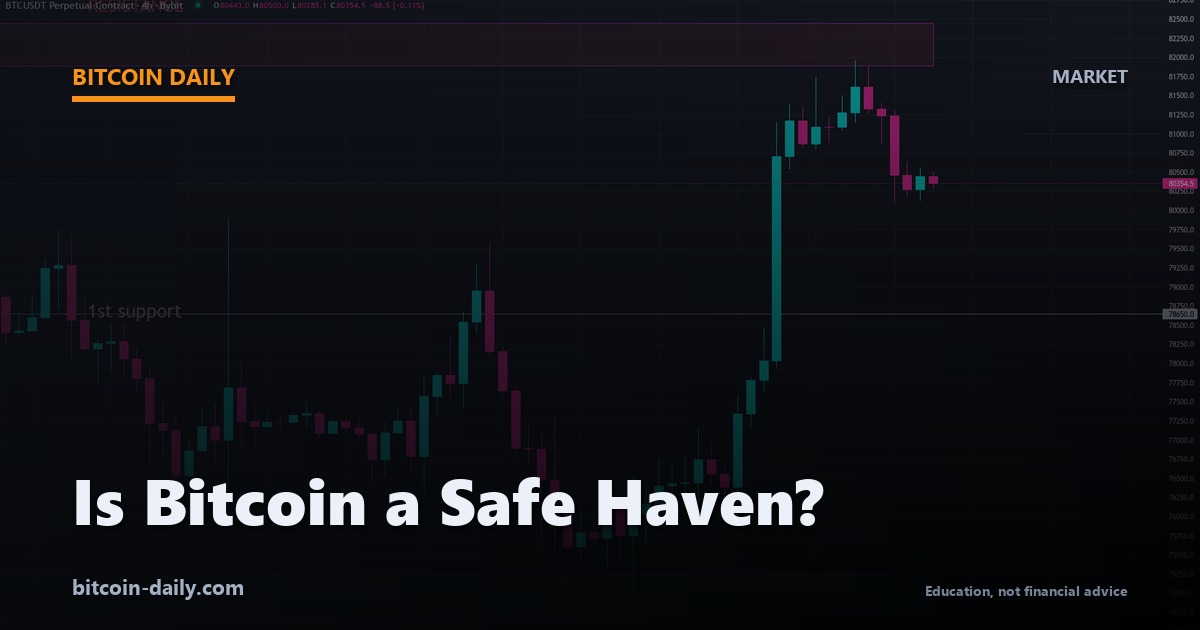
Every time something scary happens in the world, someone asks: is bitcoin a safe haven? A war breaks out, a bank collapses, tariffs land, and the question comes back like clockwork. And every time, Bitcoin answers with a face-plant.
That is not a bug. That is the answer. And it tells you something more useful than most people realize.
What a safe haven actually means
A safe haven is an asset that holds its value, or goes up, when everything else is falling apart. Gold is the classic example. Treasury bonds. Cash under a mattress. The whole point is that when panic hits, the price does not move against you.
Bitcoin does the opposite. When panic hits, Bitcoin sells off faster than stocks. It has done this every single time, without exception, for its entire history.
Bitcoin crashes when the world panics
The evidence is not subtle.
- March 2020 (COVID). The S&P 500 fell about 34% over five weeks. Bitcoin dropped roughly 50% in a single week, briefly falling below $4,000.
- November 2022 (FTX collapse). Bitcoin fell from around $21,000 to below $15,600 in days. The stock market barely flinched.
- April 2025 (tariff shock). The S&P 500 dropped about 10% over two days. Bitcoin fell 12% in one day, sliding below $75,000.
In every single panic since Bitcoin existed, it sold off harder and faster than the thing people were already panicking about. Gold went up in most of those windows. Bitcoin went down. If your definition of “safe haven” is “holds up when everything falls,” Bitcoin fails that test. It is not close.
Why Bitcoin sells off in a crisis
The reason is simple: Bitcoin trades like a risk asset. It sits on the same desks, in the same portfolios, and on the same screens as tech stocks. When fear spikes, traders sell the riskiest thing first to raise cash. Bitcoin is liquid, open 24/7, and easy to dump at 2 AM on a Sunday. So it gets dumped first.
It does not matter that Bitcoin has a fixed supply. It does not matter that no government controls it. In the moment of maximum fear, none of those things protect the price. Panic does not read whitepapers.
So what is Bitcoin actually good for?
Here is where it gets interesting. Bitcoin is terrible at protecting you from a bad week. But it might be the single best asset ever created for protecting you from a bad decade.
Every major currency on earth loses purchasing power over time. The dollar has lost over 25% of its buying power since 2000. The Turkish lira has lost over 90%. The Argentine peso barely qualifies as money anymore. This slow bleed is invisible on a daily chart but devastating over a lifetime.
Bitcoin, with its fixed cap of 21 million coins and a supply schedule that cuts in half every four years, was built to do the opposite. And over every multi-year window since it launched, it has. It crashed 50% in 2022 and still outperformed every major currency, every stock index, and gold over the prior five years.
The people who bought Bitcoin in 2020 at $9,000 watched it crash to $4,000 during COVID. Today it sits near $80,000. Gold went from $1,700 to roughly $4,200 in that same span, about 2.5x. Bitcoin did roughly 9x, and that includes every crash along the way.
A shield is not a sword
Gold is a shield. It protects you in the storm. Bitcoin is a sword. It does not protect you from the storm at all, but when the storm passes, it has historically outrun everything else by a wide margin.
The catch is that you have to survive the storm. That means sizing your position so a 50% crash does not force you to sell. It means understanding that the volatility is not a flaw. It is the price of admission.
If you need your money next month, Bitcoin is a terrible place to put it. If you are thinking in years, the track record is hard to argue with, even for the skeptics.
The honest answer
Is bitcoin a safe haven? No. Not even a little. It crashes harder than stocks in every panic, every time.
But is it a long-term store of value? So far, over every window longer than four years, the answer has been yes. And it has done that job better than anything else you could have bought.
The question people should be asking is not “will Bitcoin protect me in a crash?” It will not. The question is: “will Bitcoin be worth more in five years than it is today?” That is a different bet entirely. And so far, every person who made that bet and held through the pain has won.
Common questions
Is Bitcoin a safe haven asset?
No. Bitcoin has sold off harder than stocks during every major market panic since it launched. It trades like a high-risk asset in the short term, not like gold or treasury bonds.
Why does Bitcoin crash during a crisis?
Bitcoin is liquid, trades 24/7, and sits in the same portfolios as tech stocks. When fear spikes, traders sell the riskiest and most liquid assets first to raise cash, and Bitcoin fits that description perfectly.
Is Bitcoin better than gold as a store of value?
Over short periods during panics, gold protects better. Over multi-year windows, Bitcoin has outperformed gold by a wide margin every time, even after accounting for its crashes.
Should I buy Bitcoin to protect against inflation?
Bitcoin has outpaced inflation over every holding period longer than four years, but it can lose 50% or more in a single year. It protects against long-term currency debasement, not short-term price swings.
Keep reading
We break down the market like this every day, free on Instagram and YouTube, and in depth inside the community.
Education, not financial advice. Trading involves real risk.