Why Is Bitcoin So Volatile? (And Why It Keeps Calming Down)
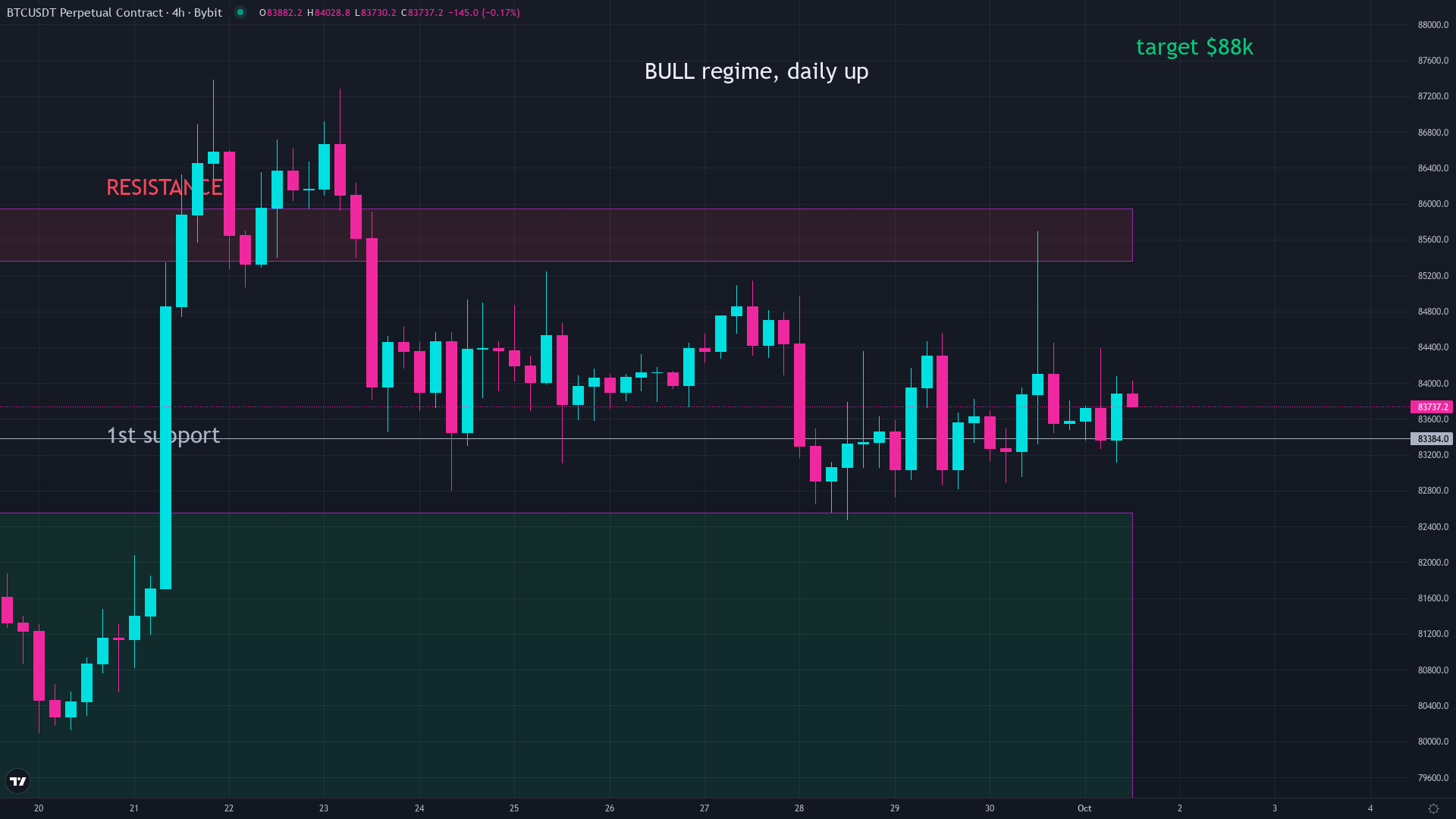
Type “Bitcoin” into any search bar and within three suggestions you will see it. Why is Bitcoin so volatile? It is the first question every new buyer asks, usually right after watching the price drop 10% in a weekend. Fair question. But the more interesting answer is hiding inside the data: yes, Bitcoin swings hard, and every cycle those swings get smaller.
Why is Bitcoin so volatile? Five forces behind the swings
Bitcoin does not move like a savings account. It moves like a brand-new market still figuring out what it is worth. Here are the five biggest reasons.
- Fixed supply meets shifting demand. Only 21 million Bitcoin will ever exist. When a wave of new buyers shows up, there is no central bank to print more and calm the price. Supply is locked, so demand does ALL the moving.
- It trades 24/7 with no circuit breakers. The stock market closes at 4 PM and has automatic pauses when things fall too fast. Bitcoin never sleeps and never pauses. Weekend panics can snowball before most people even check their phones.
- Leverage amplifies everything. Traders borrow money to bet bigger. When the price moves against them, exchanges force-sell their positions automatically. Those forced sales push the price further, which forces more sales. One bad move can trigger a chain reaction. We track that pressure on our squeeze-risk gauge.
- It is still young. Gold has been traded for thousands of years. The S&P 500 has decades of pension funds and index money smoothing out daily moves. Bitcoin launched in 2009. A single large holder selling can still move the price in ways that would barely register in the stock market.
- Headlines hit harder. A government ban rumor, an exchange hack, or a single tweet from a public figure can send Bitcoin 5% in an hour. Because the market is global and always open, news gets priced in instantly, not at the next morning’s bell.
Every Bitcoin crash has been smaller than the last
This is the part most people miss. Bitcoin is volatile, but it is getting less volatile over time. Look at the worst crash in each cycle.
- 2011: fell about 94% from top to bottom.
- 2013 to 2015: fell about 87%.
- 2018: fell about 84%.
- 2022: fell about 77%.
- 2025: fell about 33% from its all-time high to its lowest point so far.
The pattern is clear. Each cycle’s worst drop has been shallower than the one before. More long-term holders, more institutional money, and deeper markets all act like shock absorbers. The ride is still bumpy. It is just less bumpy than it used to be. You can see how every past crash compares on our live crash-comparison chart.
Volatility is not the same as risk
This is where most people get it backwards. They see a 15% drop and call it “risky.” But risk depends on your time horizon.
If you need that money next week, yes, a 15% swing is a problem. But if you are holding for years, that same swing is just noise on a chart that has gone from under one dollar to over $80,000. Every person who bought Bitcoin during a crash and held for at least four years has been profitable. Every single one.
Volatility is the price of admission. You cannot get the long-term returns without sitting through the short-term chaos. That is the deal, and it has not changed since day one.
Where Bitcoin sits right now
As of October 2026, Bitcoin trades near $83,400. Its implied daily swing is about 2%, meaning the market expects it to move roughly $1,600 up or down on a typical day. The Fear and Greed Index reads 74, which is in “Greed” territory.
The daily trend is up, but the shorter-term charts are flat. In plain terms, Bitcoin rallied off its summer lows and is now pausing to decide its next move. A 2% daily swing is actually quiet by Bitcoin standards. Back in 2022, daily moves of 5% or more were common.
What this means if you are thinking about buying
If Bitcoin’s wild moves scare you, that is normal. But know two things.
First, the volatility is not random chaos. It follows a pattern tied to Bitcoin’s roughly four-year cycle. Understanding the cycle does not remove the swings, but it tells you where in the ride you probably are.
Second, the swings are shrinking. The Bitcoin of 2011, where the price could lose 94% in a few months, is not the Bitcoin of 2026. Deeper markets, bigger holders, and regulated products like ETFs have all added weight to the ship. It still rocks. It just does not capsize the way it used to.
Volatility is not a bug. It is the feature that lets a $0 asset reach six figures in fifteen years. The question is not whether Bitcoin is volatile. It is whether you have the stomach and the time horizon to sit through it.
Common questions
Why is Bitcoin so volatile?
Bitcoin has a fixed supply of 21 million coins, trades around the clock with no circuit breakers, and is still a young market. When demand shifts, there is no central authority to smooth out the price. Leverage and instant global news flow amplify every move.
Is Bitcoin volatility decreasing over time?
Yes. Each cycle's worst crash has been smaller than the one before, from a 94% drop in 2011 to about 33% in 2025. Deeper markets, more long-term holders, and institutional products like ETFs are gradually dampening the swings.
Is Bitcoin too volatile to invest in?
It depends on your time horizon. Short-term swings of 10% or more are common, but every person who held Bitcoin for at least four full years has ended up profitable historically. Volatility is the cost of the long-term upside.
What makes Bitcoin crash?
Crashes are usually triggered by a mix of forced liquidations from leveraged traders, negative headlines like exchange failures or regulation fears, and panic selling that feeds on itself in a 24/7 market with no pause button.
How volatile is Bitcoin compared to stocks?
Bitcoin is roughly three to five times more volatile than global stocks on a daily basis. However, some individual tech stocks like Tesla and Nvidia have had stretches of similar volatility.
Keep reading
We break down the market like this every day, free on Instagram and YouTube, and in depth inside the community.
Education, not financial advice. Trading involves real risk.